One plan for every sport you train.

Lifting, running, riding, swimming, hybrid racing and more, planned together around your week and the equipment you have. Build to a race, set a number of weeks, or keep it going. Check in each morning and your session adjusts.

The iPhone app is coming to the App Store. The web app runs in your phone’s browser; add it to your home screen to use it like an app.

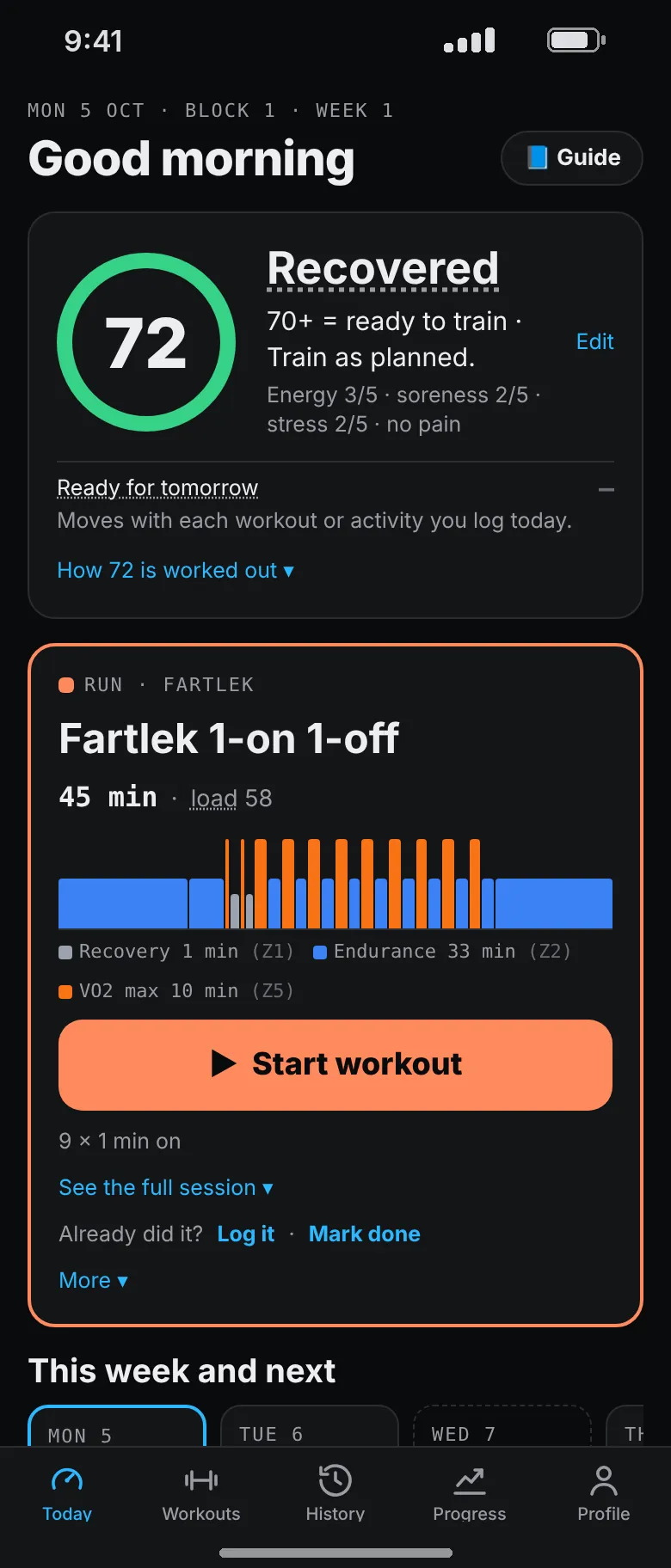
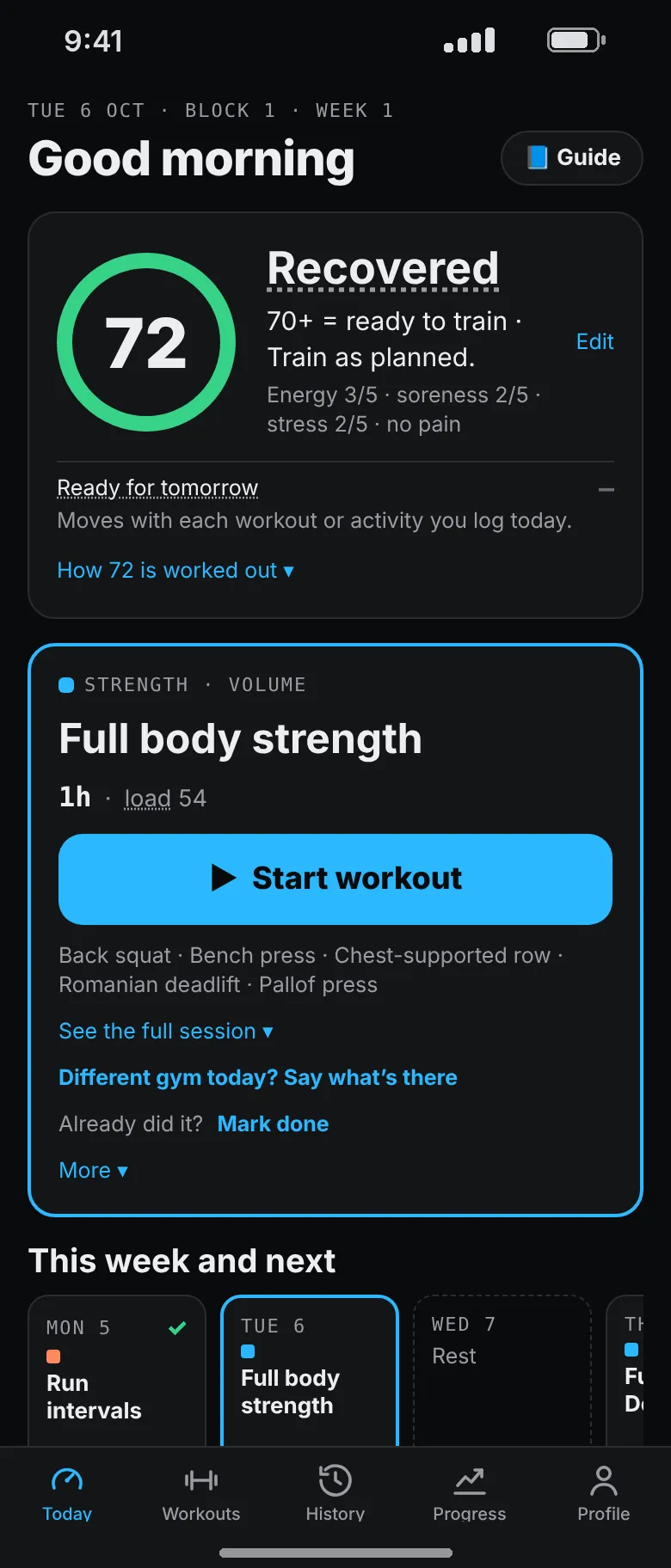
Axial’s Today screen: a readiness score of 72 saying recovered, train as planned, then a full body strength session with a Start workout button, and the week ahead.
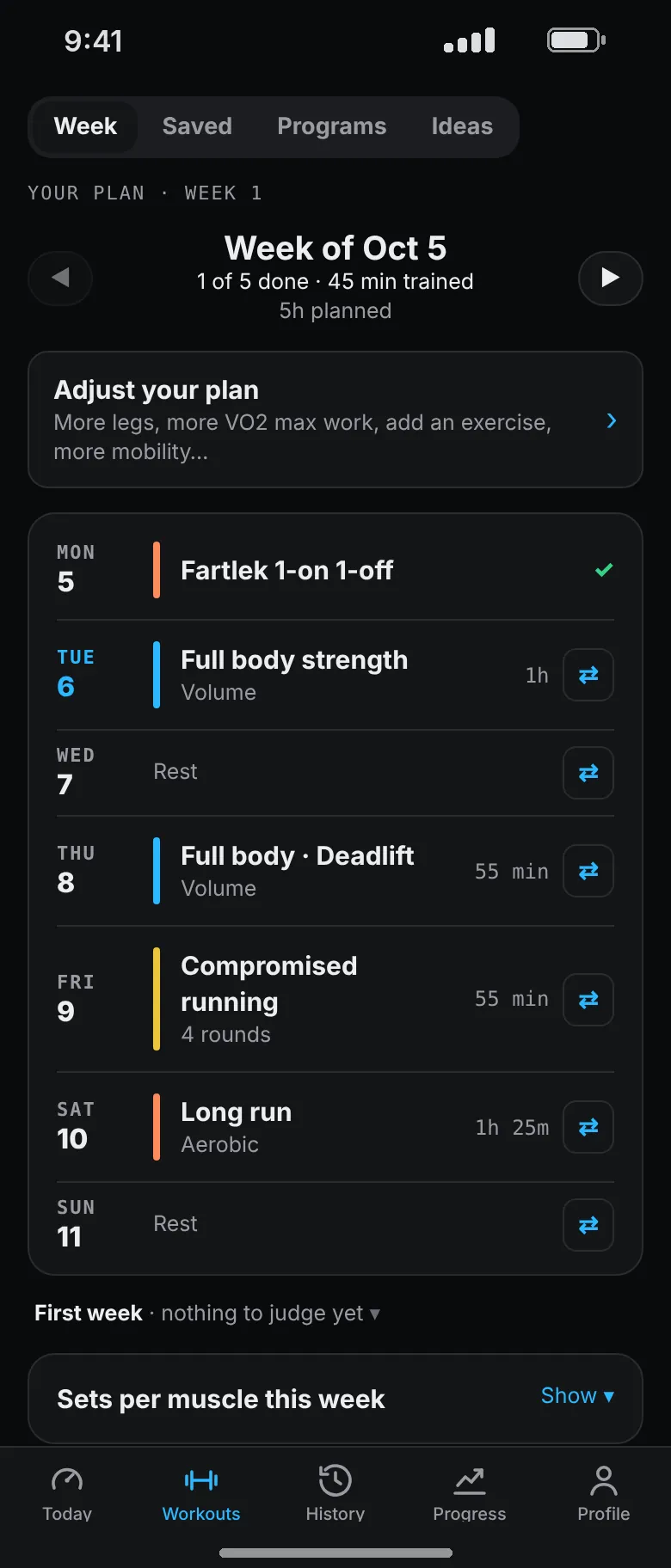
Axial’s plan for one week: a fartlek run, two strength days, compromised running for hybrid racing, and a long run, each marked with a color for its sport.

Train for several things at once.

Pick every goal you have and one to lead with. Axial fits them all into one week.

Choose one to see a real week and a session.

Squat, bench, deadlift and press in blocks that build from week to week.
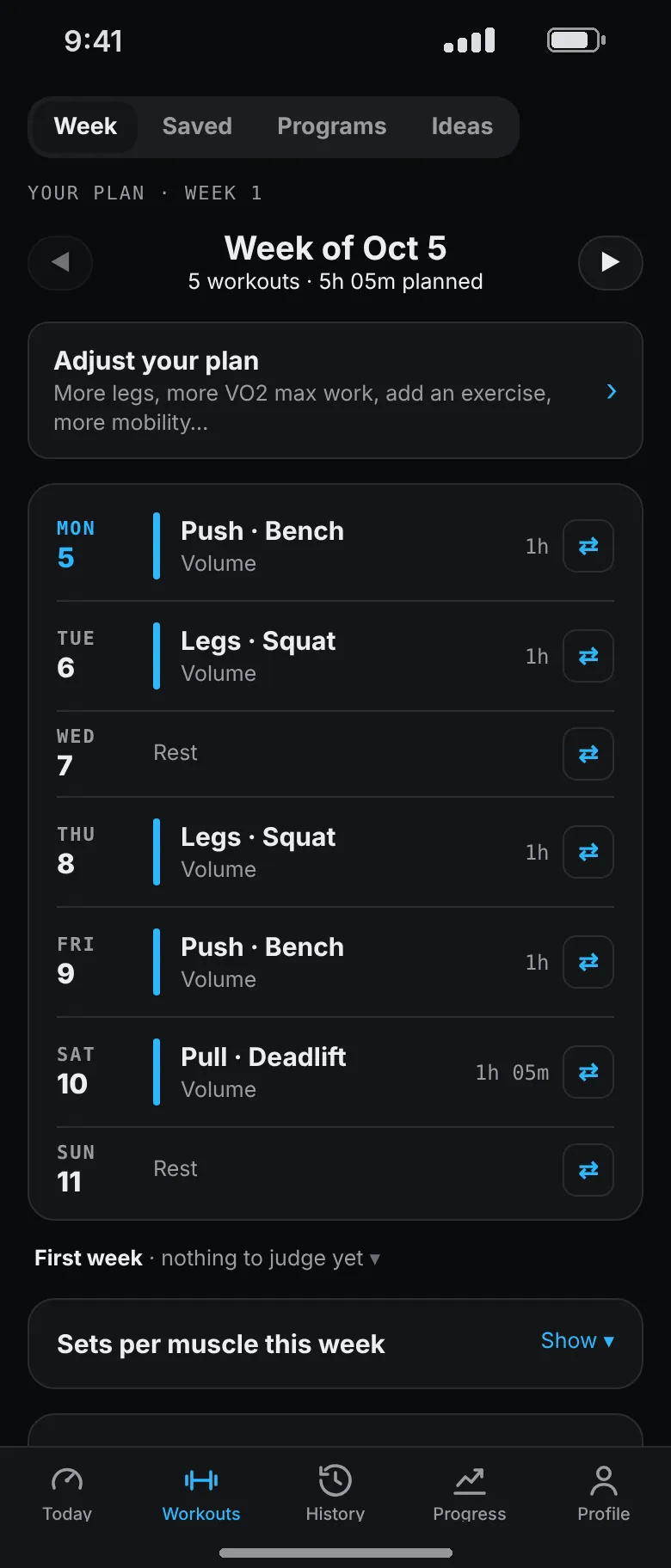
Week 1 of a strength plan: Push · Bench, Legs · Squat, Legs · Squat, Push · Bench and Pull · Deadlift, with rest on Wednesday and Sunday.
Week 1
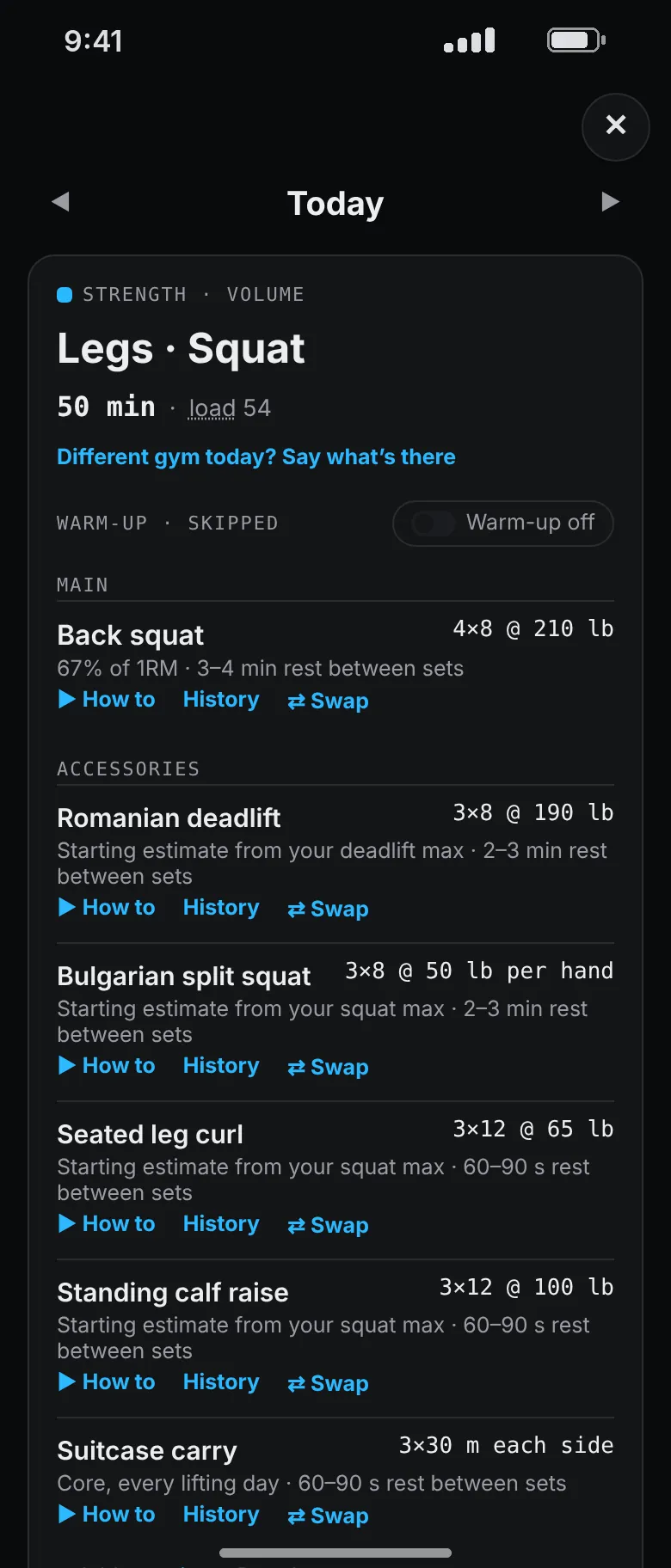
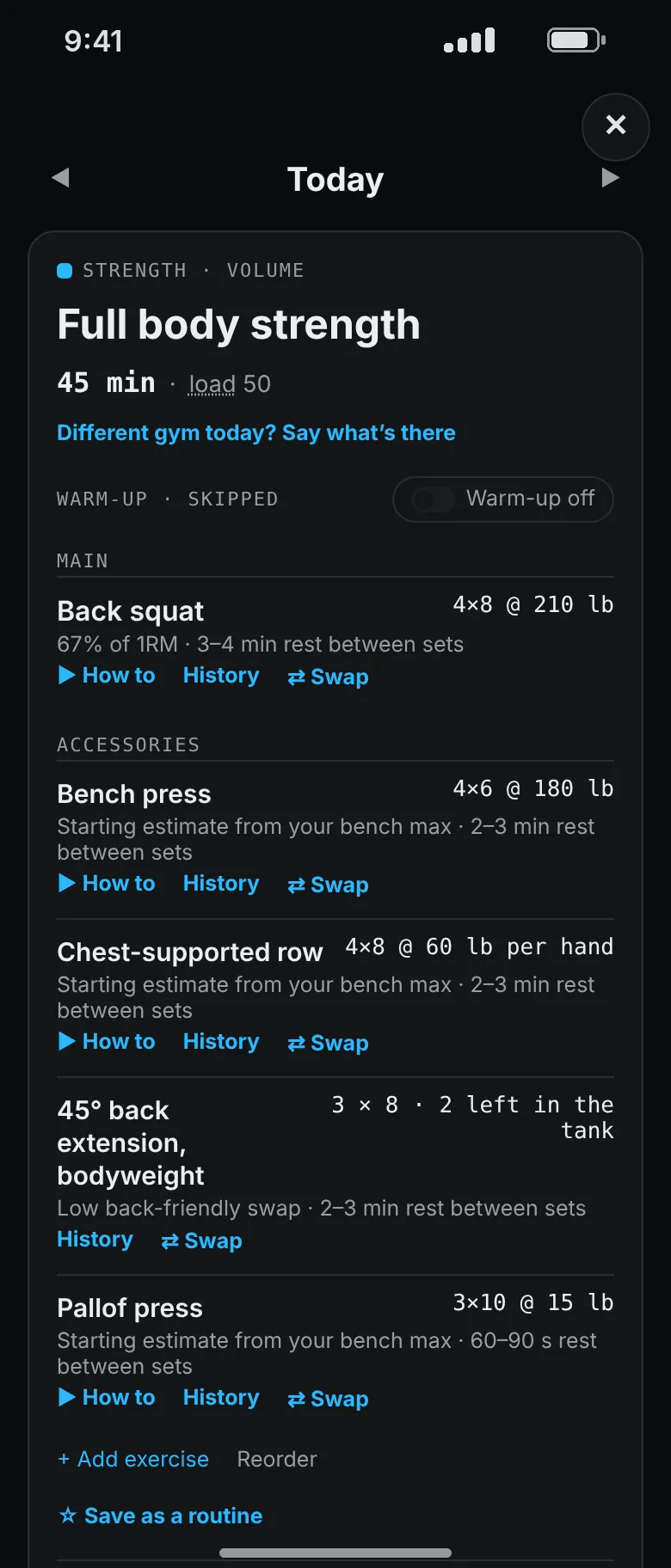
The main set of a squat day: back squat, 4 sets of 8 at 210 pounds and 67% of the athlete’s max, then Romanian deadlifts, split squats, leg curls, calf raises and carries.
Today’s squat session

Sample athlete with a 315 lb squat max. The back squat is 4×8 at 210 lb, 67% of it.

Weekly volume for every muscle, trained close to failure, with the areas you want to bring up getting extra.
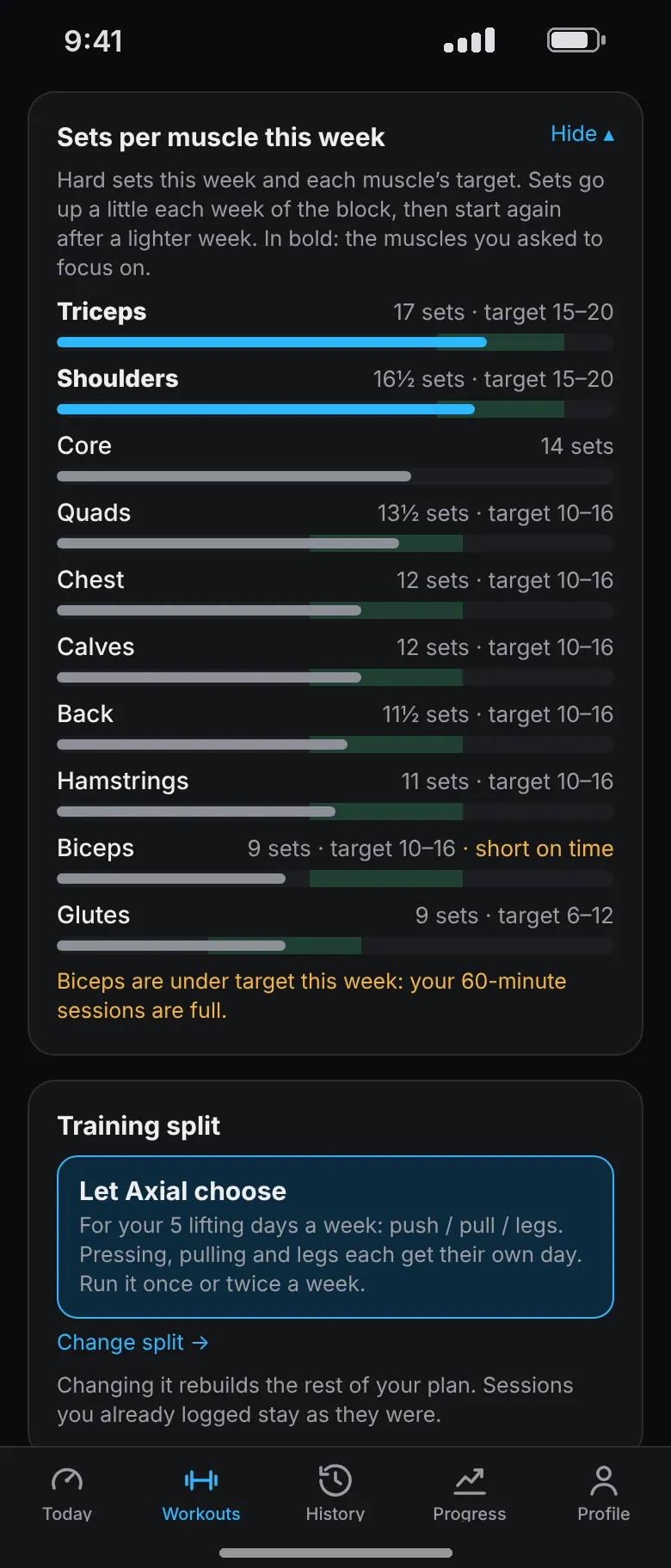
Sets per muscle this week: a bar for each muscle against its target range, with shoulders and triceps in bold as focus areas, above the training split set to Let Axial choose.
Sets per muscle
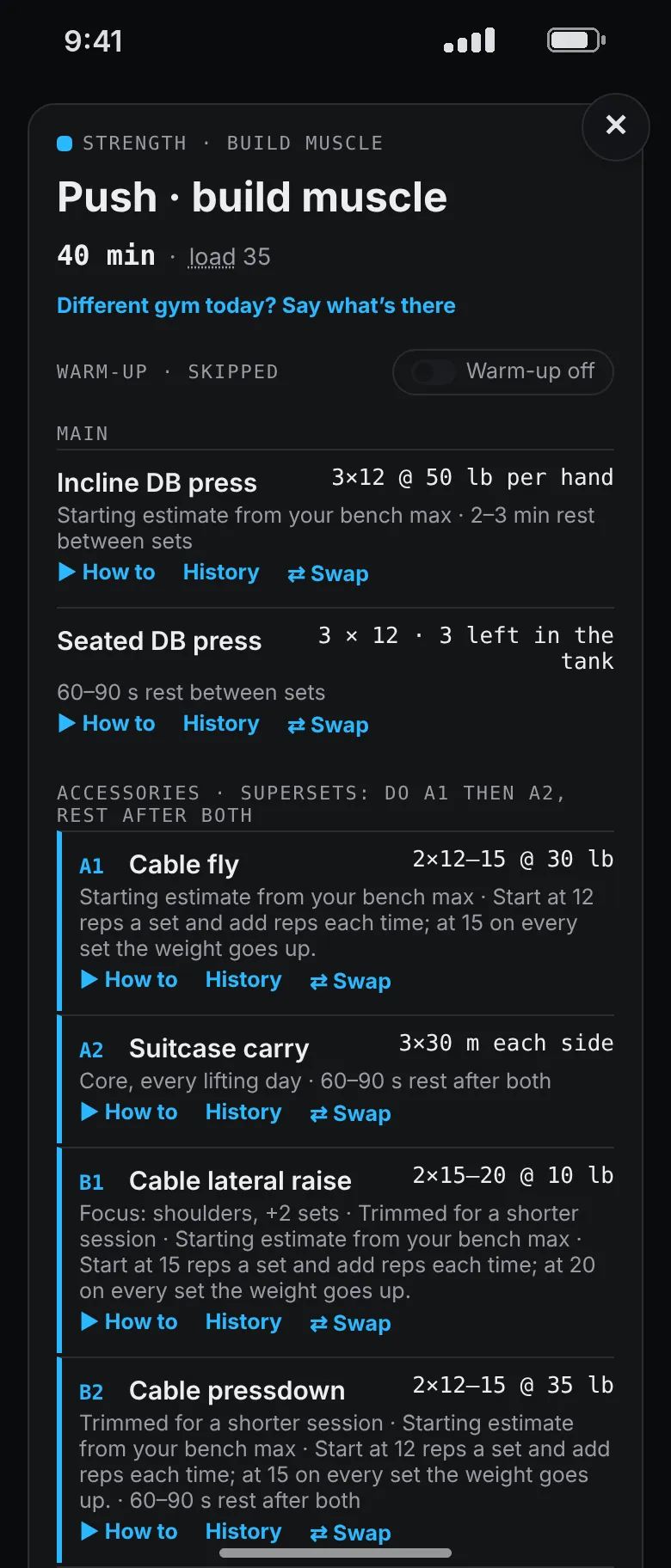
A push day: incline dumbbell press and seated dumbbell press, then accessories as supersets, cable fly with suitcase carry and cable lateral raise with cable pressdown, each with a starting load and a note that the shoulder exercise has two extra sets as a focus area.
A push day

Sample athlete with a 205 lb bench and shoulders and triceps as focus areas. They get extra sets, and accessories come paired as supersets.

From 5K to marathon: easy runs, intervals, tempo work and the long run.
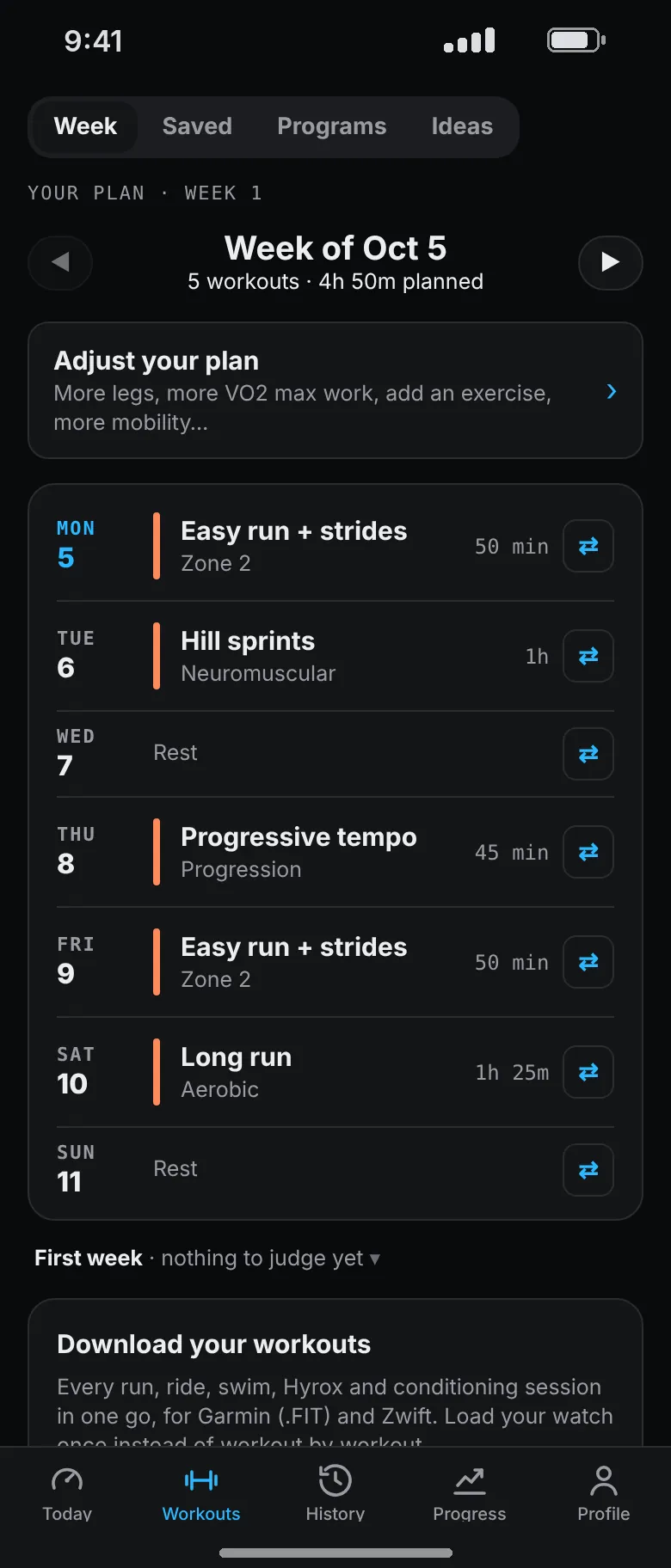
Week 1 of a running plan: an easy run with strides, hill sprints, progressive tempo, another easy run with strides and a long run, with rest on Wednesday and Sunday.
Week 1
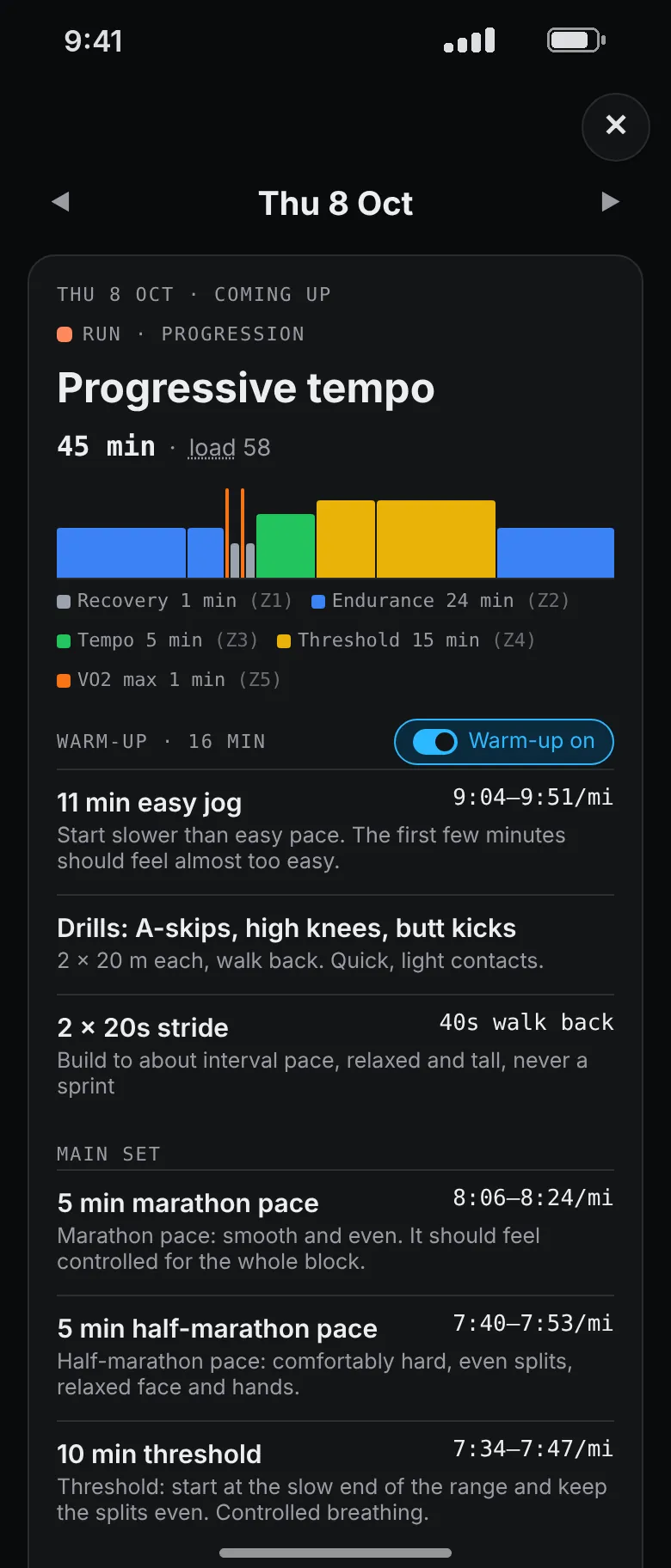
A progressive tempo run: a zone chart, a warm-up with drills and strides, then 5 minutes at marathon pace, 5 at half-marathon pace and 10 at threshold, each with a pace range.
Thursday: progressive tempo

Sample athlete with a 22:30 5K. The tempo builds from 8:06 a mile at marathon pace to 7:34 at threshold.

Intervals in power zones and long rides, spaced around your hard days.
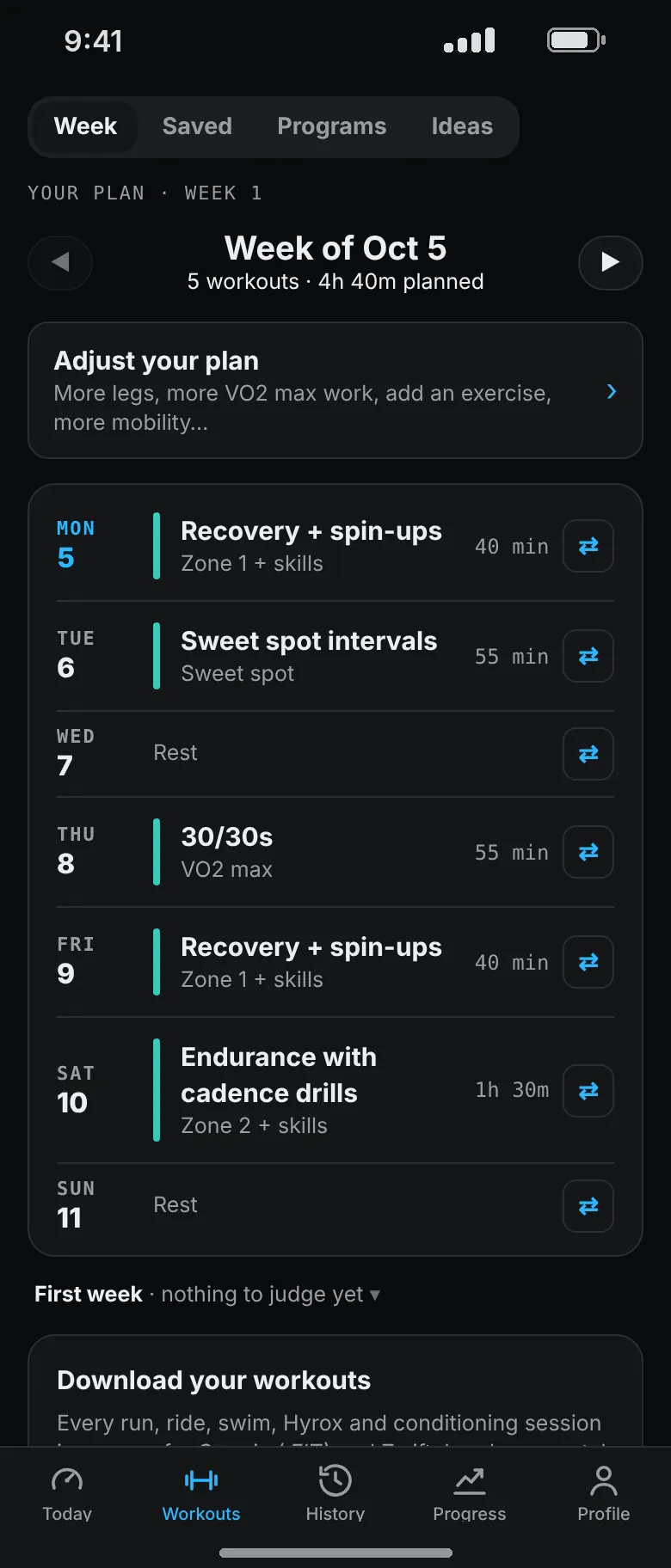
Week 1 of a cycling plan: a recovery spin with spin-ups, sweet spot intervals, 30/30s, another recovery spin and an endurance ride with cadence drills, with rest on Wednesday and Sunday.
Week 1
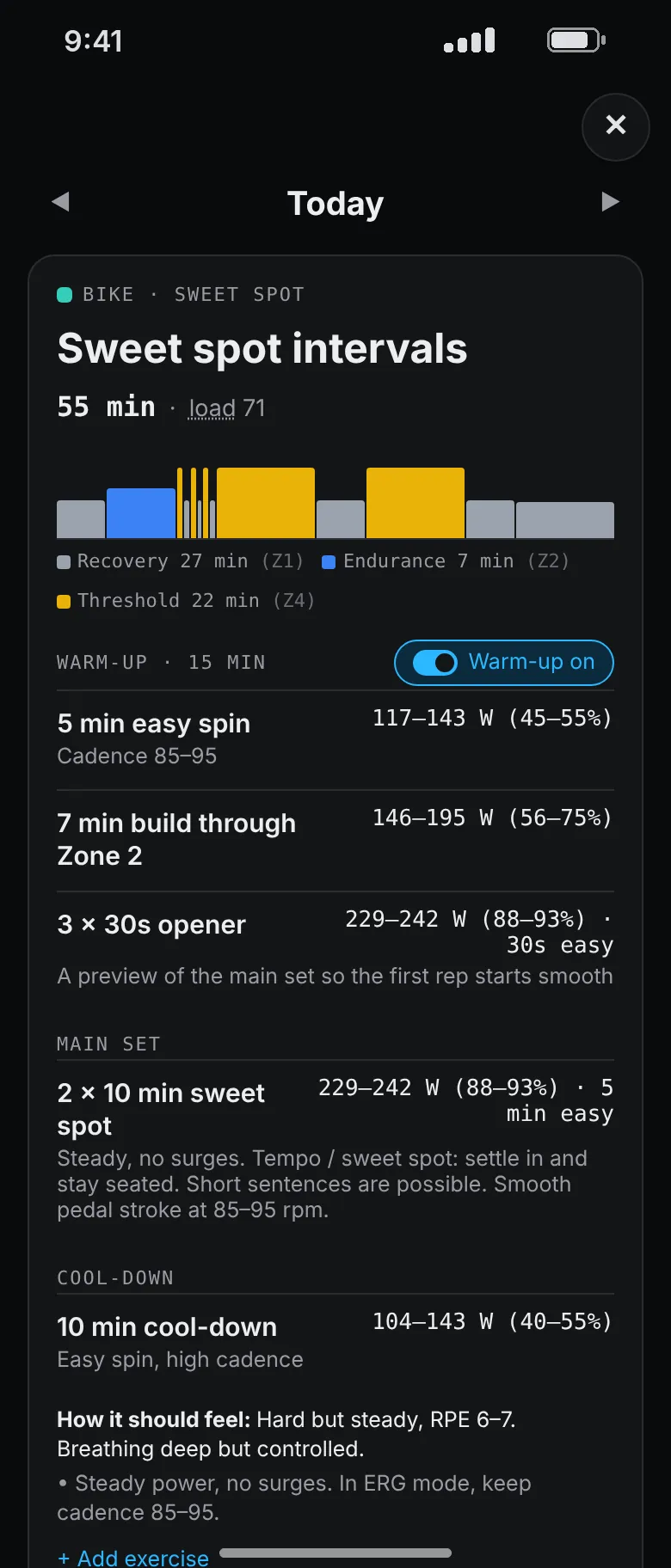
A sweet spot interval ride: a zone chart, a warm-up, two 10-minute blocks at 229 to 242 watts and a cool-down, each with a power range.
Tuesday: sweet spot intervals

Sample athlete with a 260 W FTP. The sweet-spot blocks are 229 to 242 W.

Pool sets from easy aerobic work to hard repeats.
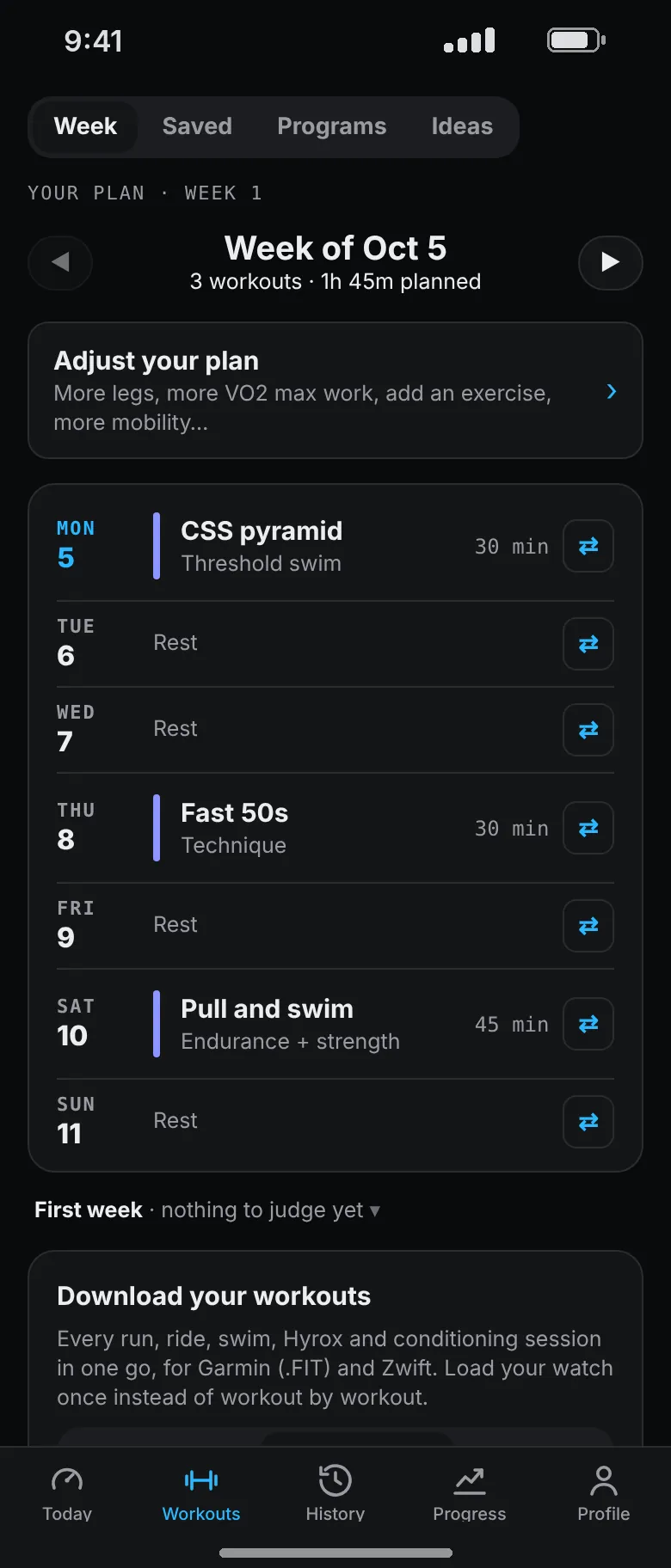
Week 1 of a swimming plan: a CSS pyramid on Monday, fast 50s on Thursday and a pull and swim set on Saturday, with rest on the other days.
Week 1
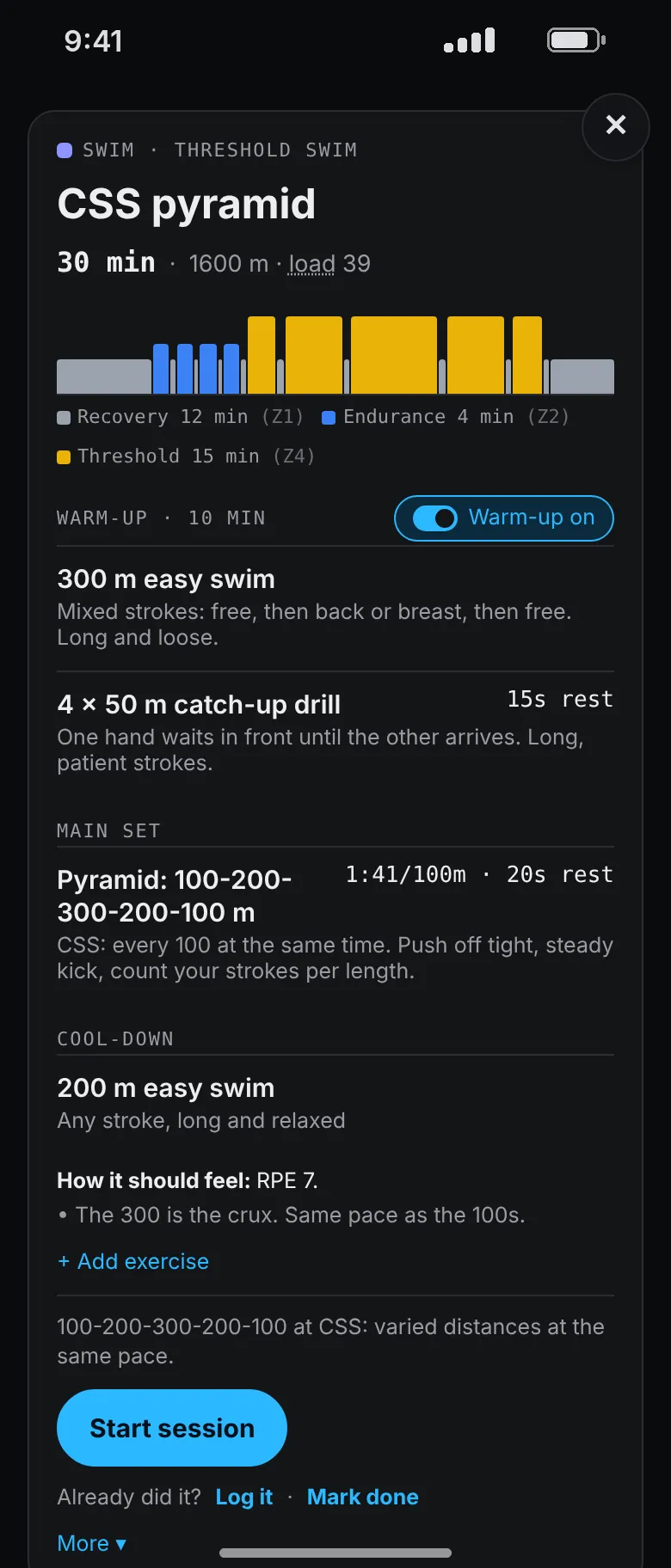
A CSS pyramid swim, 30 minutes and 1,600 meters: a zone chart, a warm-up, a 100-200-300-200-100 meter pyramid at 1:41 per 100 meters and a cool-down.
Monday: CSS pyramid

Sample athlete with a 1:40 per 100 m threshold. The pyramid is swum at 1:41 per 100 m.

Swim, bike and run in one week, with brick sessions.
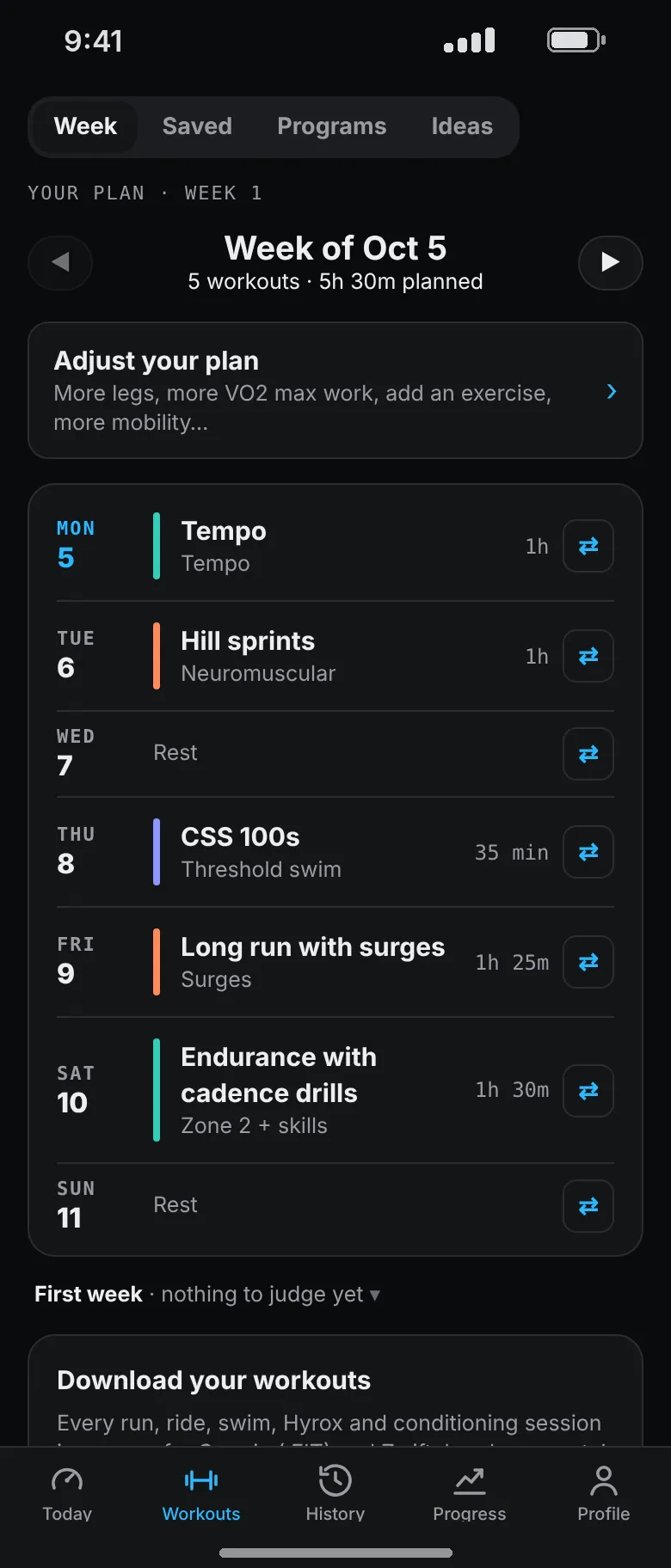
Week 1 of a triathlon plan: a tempo ride, hill sprints, a threshold swim, a long run with surges and an endurance ride with cadence drills, with rest on Wednesday and Sunday.
Week 1
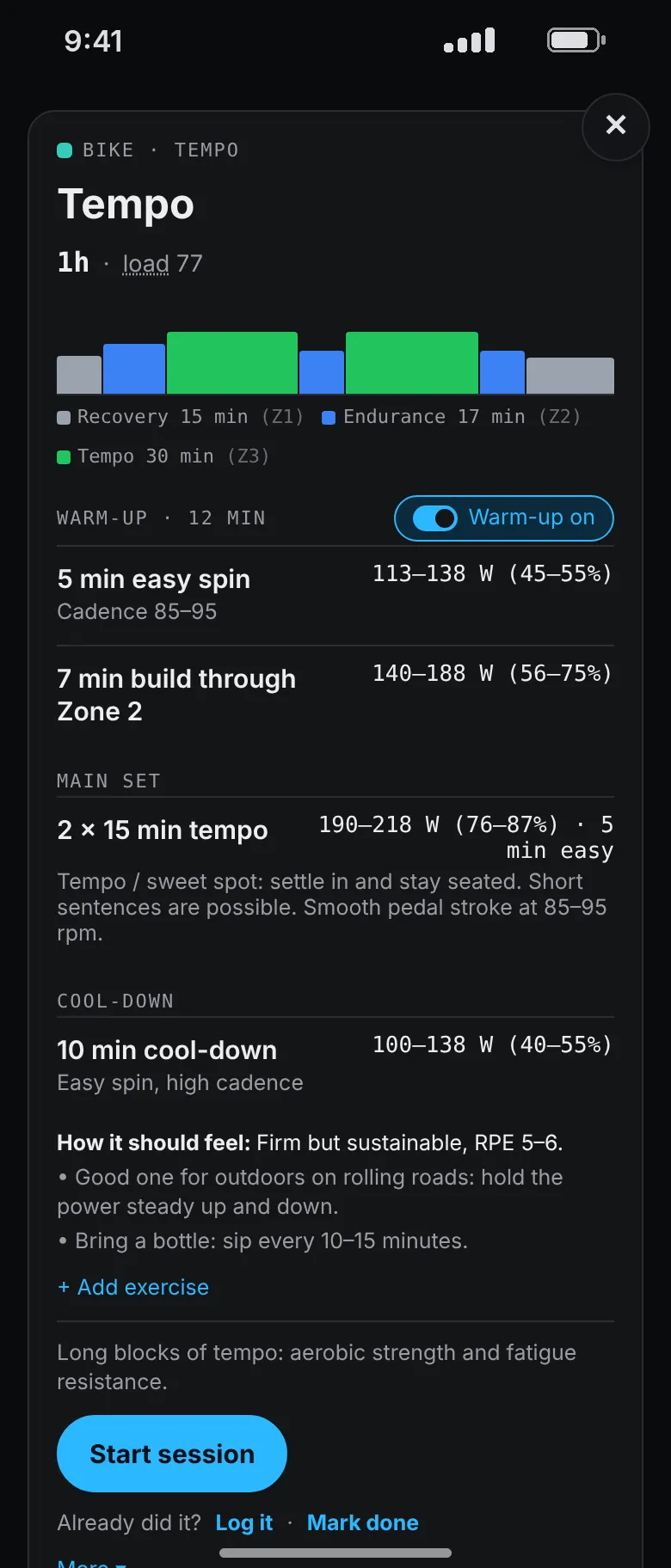
A tempo ride: a zone chart, a warm-up, two 15-minute blocks at 190 to 218 watts with 5 minutes easy between, and a cool-down.
Monday: tempo ride

Sample athlete with a 22:30 5K, a 250 W FTP and a 1:45 per 100 m threshold. The tempo blocks are 190 to 218 W.

Division weights, compromised running and the strength work behind them.
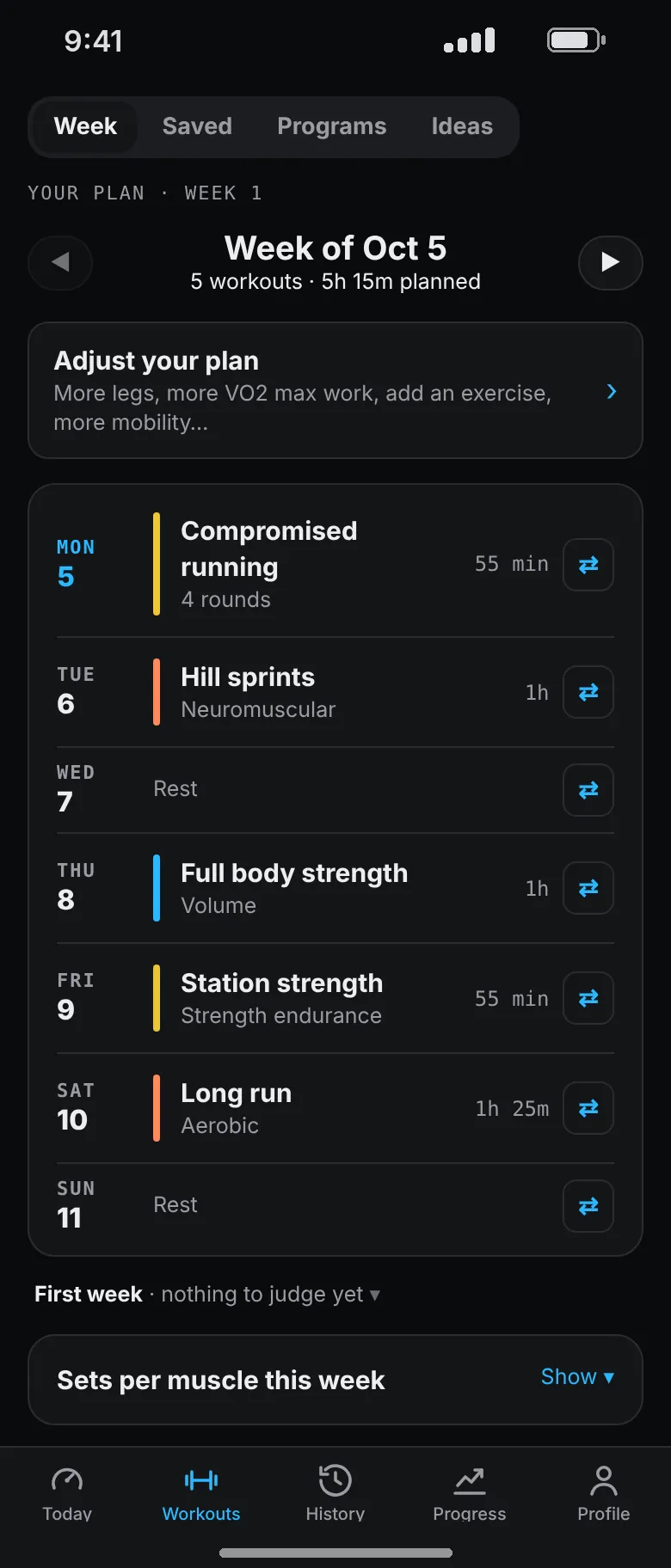
Week 1 of a hybrid racing plan: compromised running, hill sprints, full body strength, station strength and a long run, with rest on Wednesday and Sunday.
Week 1
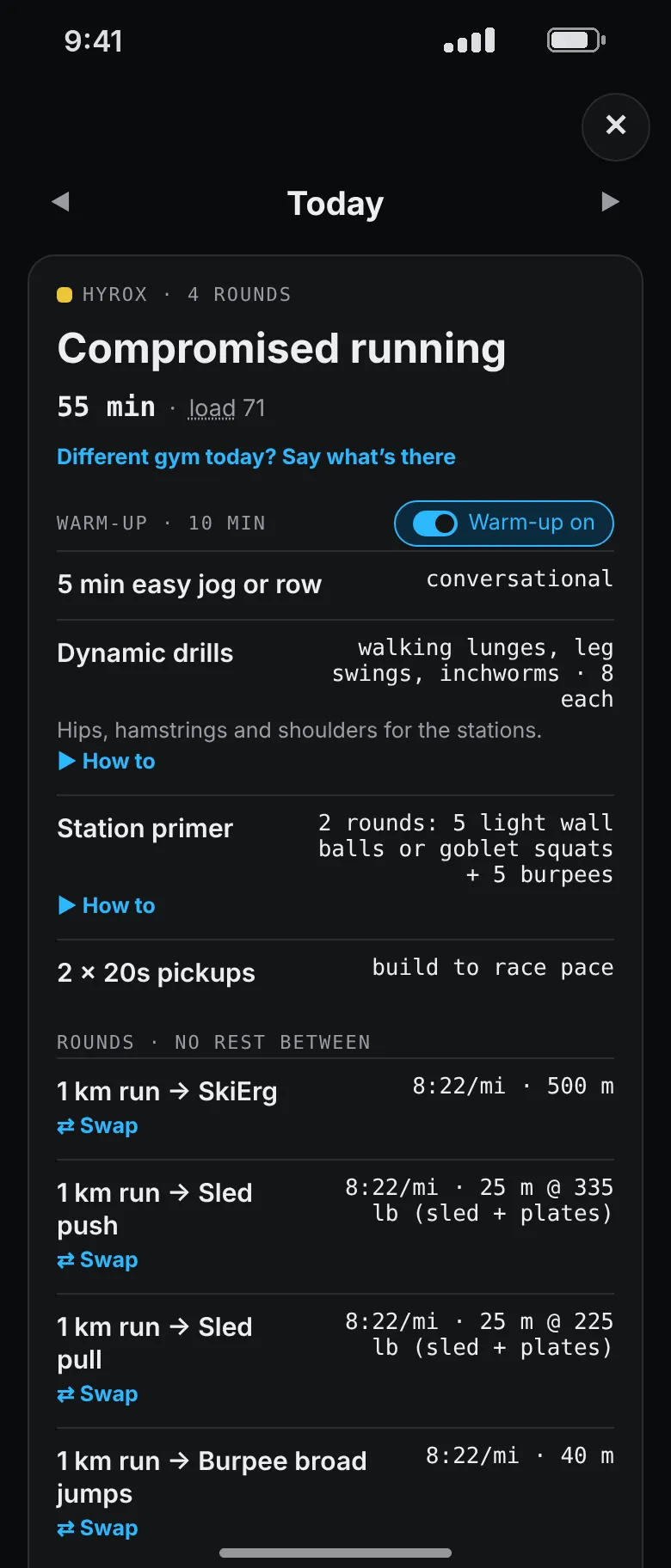
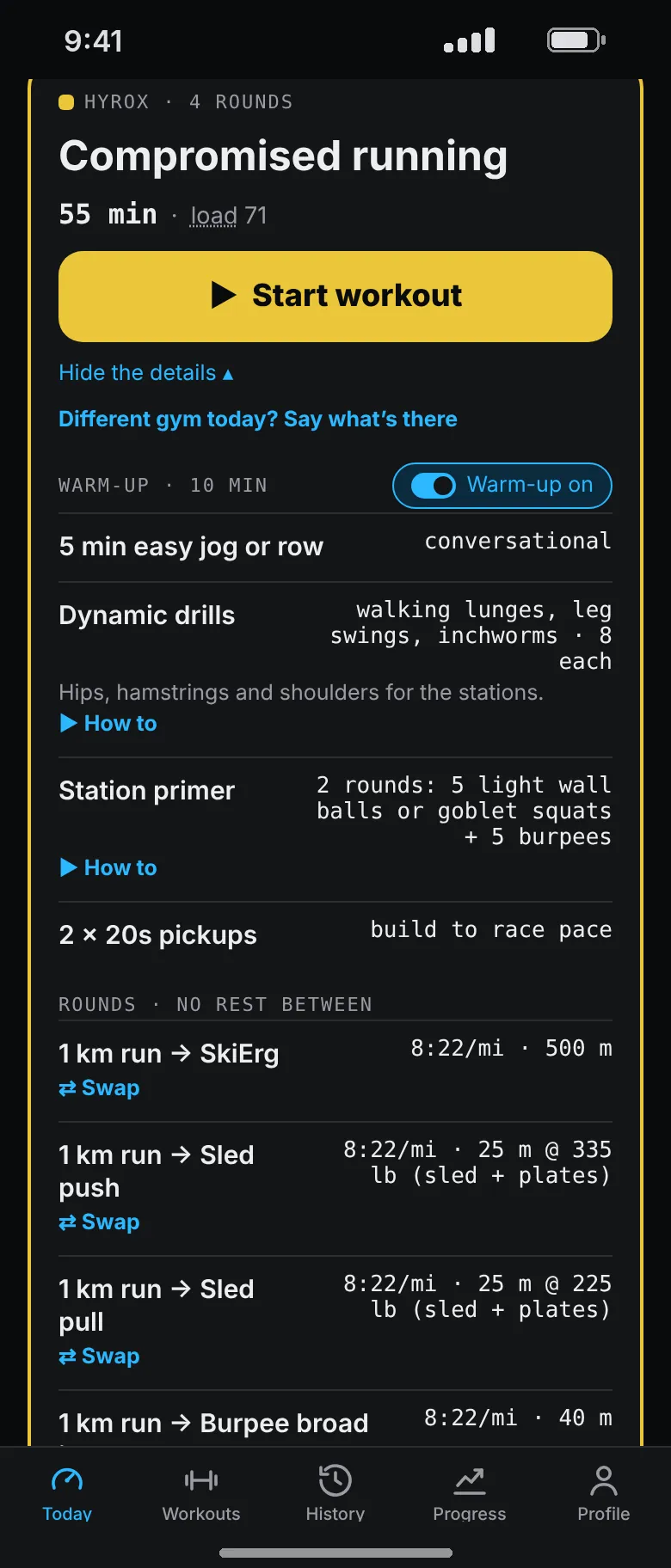
A compromised running session: warm-up, a station primer, then rounds of a 1 km run into the Ski erg, sled push at 335 pounds and sled pull at 225 pounds.
Monday: compromised running

Sample athlete in Men Open. Sled push is 335 lb and sled pull is 225 lb, each after a 1 km run.

Intervals, metcons and mixed aerobic work.
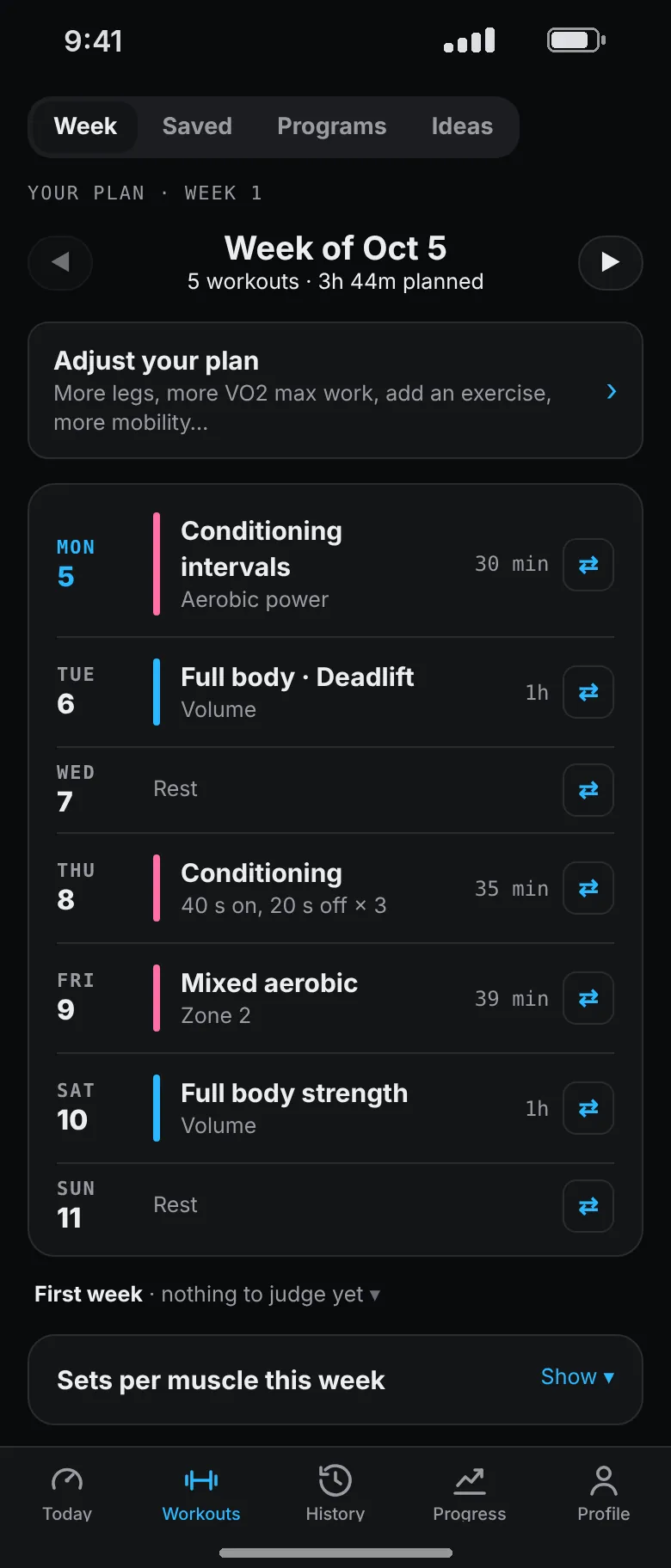
Week 1 of a conditioning plan: conditioning intervals, a deadlift day, a metcon, mixed aerobic work and a full body strength day, with rest on Wednesday and Sunday.
Week 1
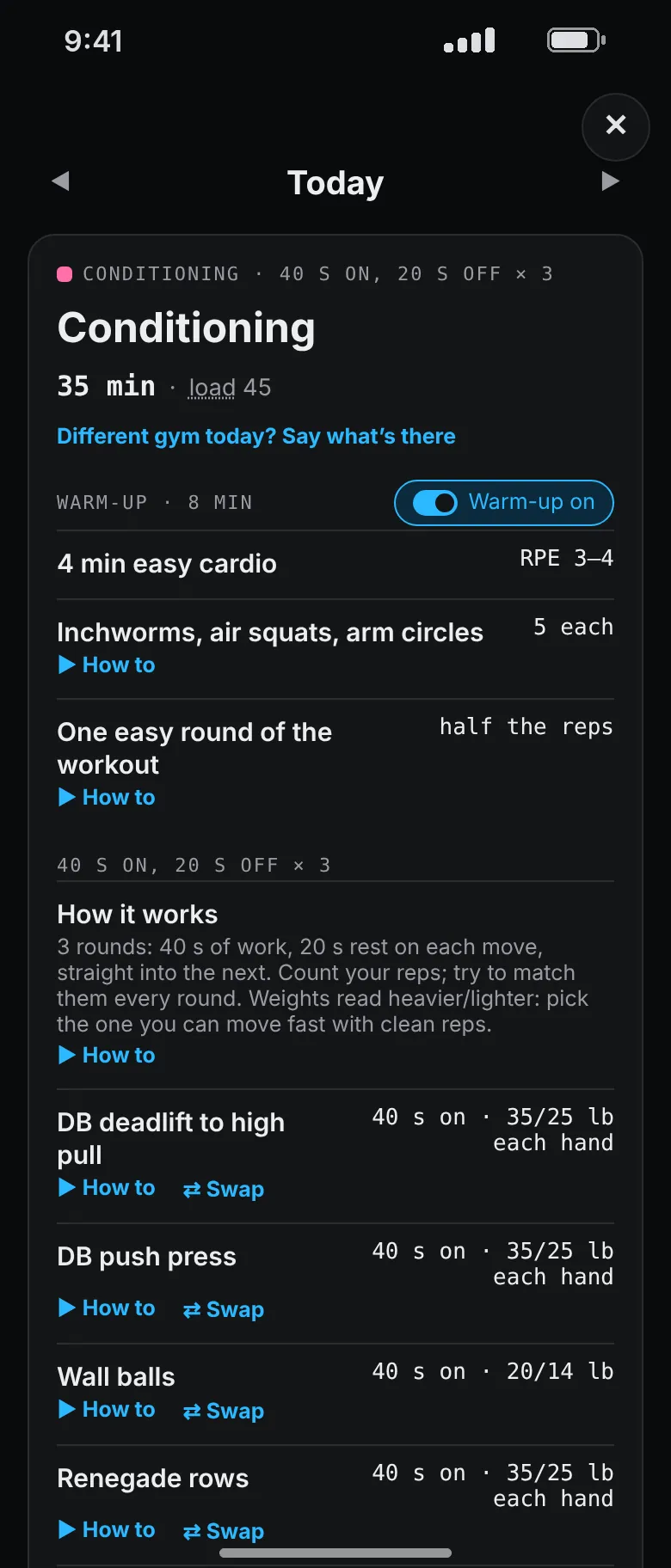
A metcon: three rounds of 40 seconds on and 20 off with dumbbell deadlift to high pull, push press, wall balls and renegade rows.
Thursday: metcon

A metcon is three rounds of 40 seconds on and 20 off, with loads set for you.

Racing? Add the date and the plan counts back from it: base, build, peak, taper. Want a set block? Choose the number of weeks. Neither? It keeps going, with deloads built in.
How it works

  1. Tell Axial about you

    Your goals, rough current numbers, training days, session length, equipment and any injuries.

  2. Get your plan

    Every week laid out session by session, with exercises, loads and paces. Anything your equipment can’t do is swapped for the closest option.

  3. Check in each morning

    Rate your energy, soreness and stress, flag any pain, and add numbers from a watch or ring if you have them. It takes a minute and sets the day.

Same plan, three mornings.

Choose how you feel and watch Tuesday change.

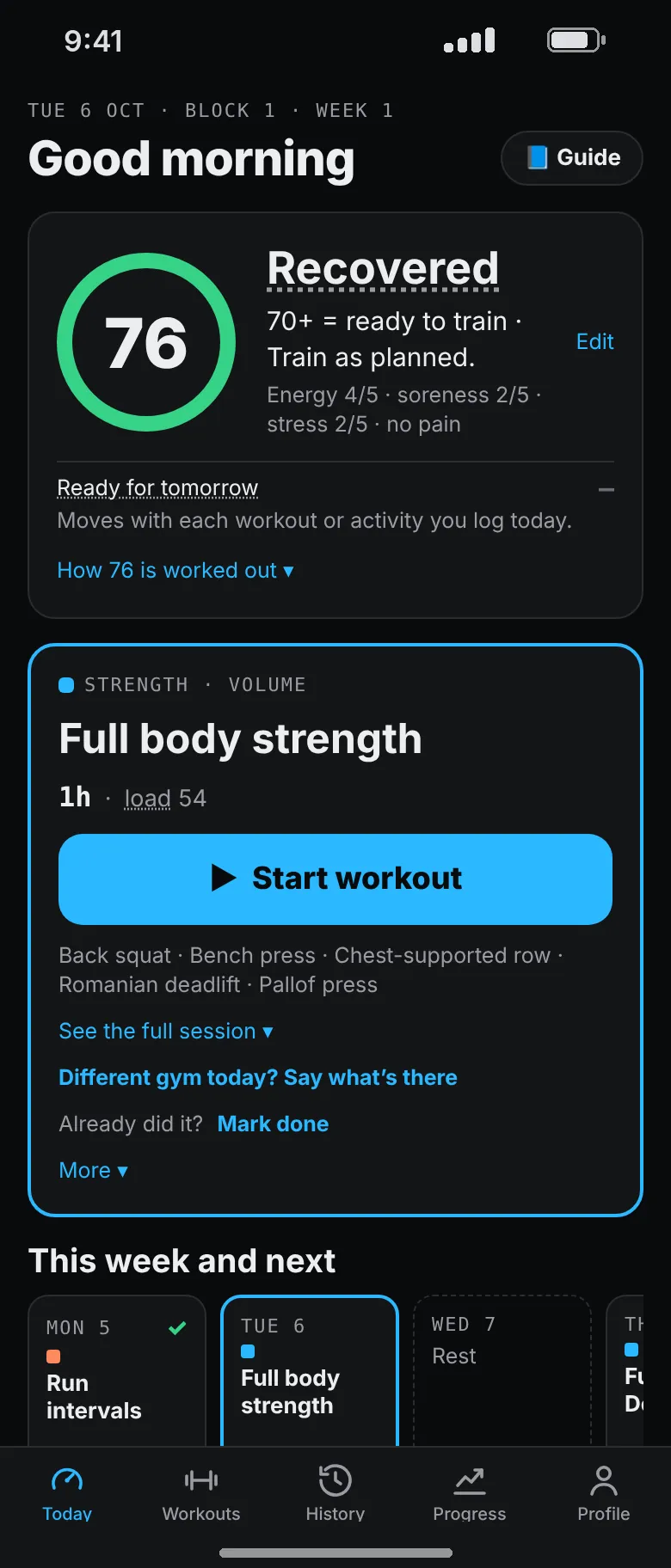
Recovered. Train as planned.

Full body strength, 1h. Nothing changes.

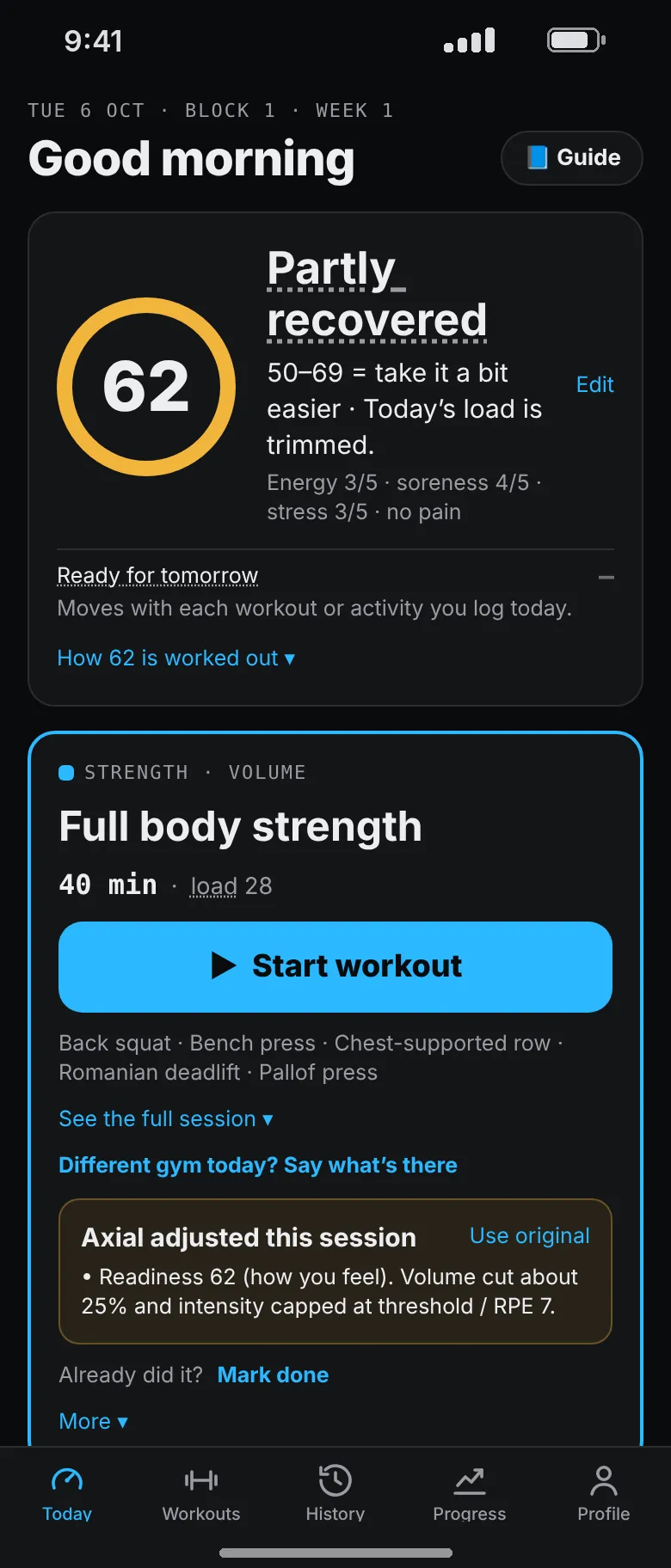
Partly recovered. Today’s load is trimmed.

Full body strength, 40 min. Volume cut about 25% and intensity capped at RPE 7.

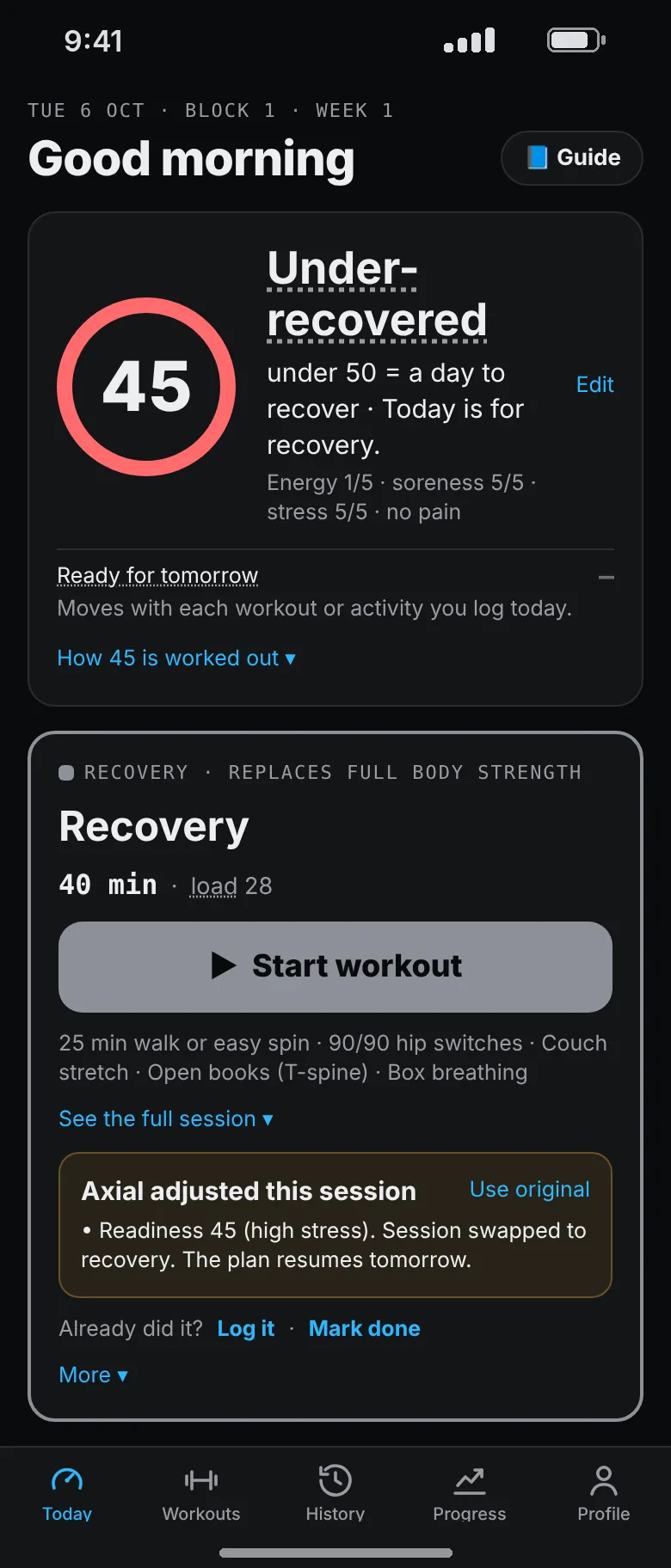
Under-recovered. Today is for recovery.

Swapped for a 40 min recovery session. The plan resumes tomorrow.

Today screen after a good check-in: readiness 76, recovered, at the top, then a full body strength session of 1 hour. Today screen after a rough check-in: readiness 62, partly recovered, at the top, then the full body strength session cut to 40 minutes with a note saying volume is down about 25%. Today screen after a very rough check-in: readiness 45, under-recovered, at the top, then the day swapped for a 40 minute recovery session.

It keeps adjusting after day one.

Choose one to see it in the app.

Deloads when you need them

Axial calls a deload week when your readiness, effort and pain reports say you need one. Prefer a schedule? Fix it at every 4th, 5th or 6th week.

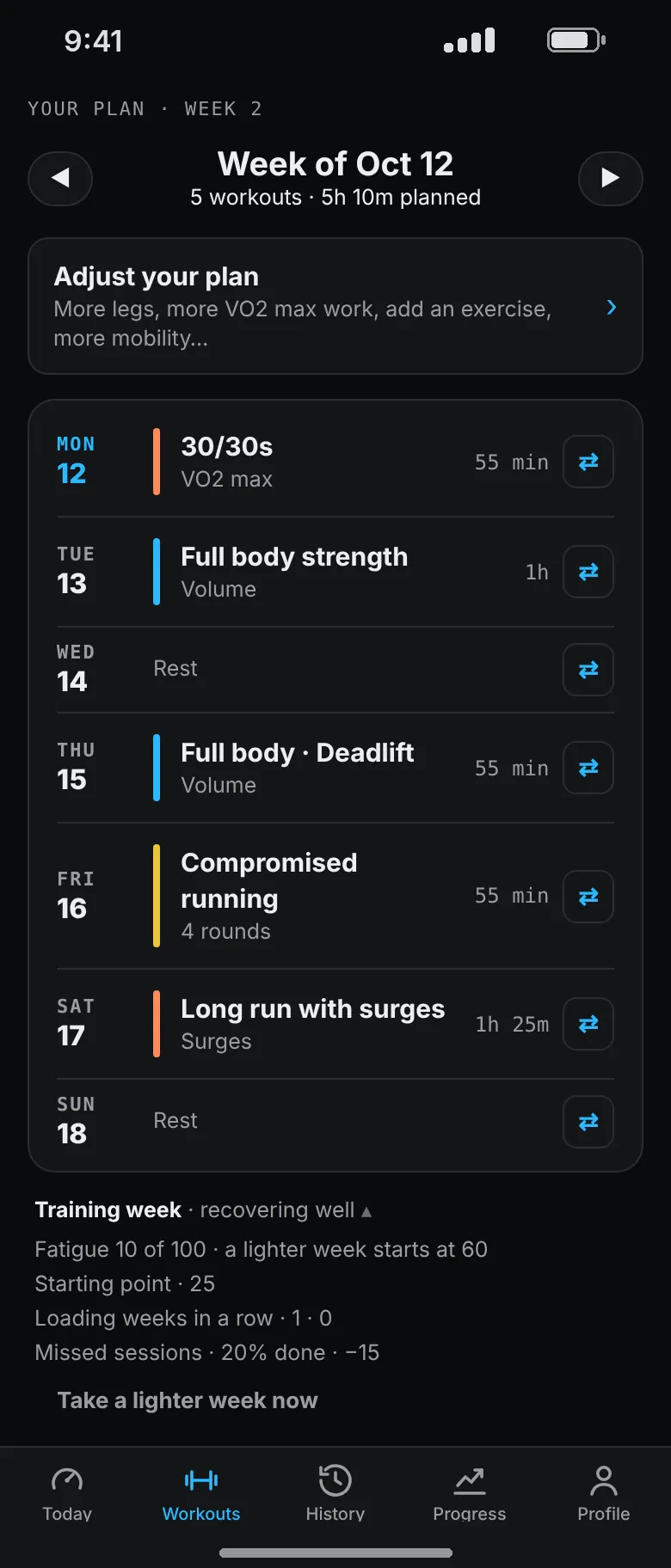
Week 2 is 5 h 10 min: 30/30s intervals, two lifting days, hybrid race running and a long run.

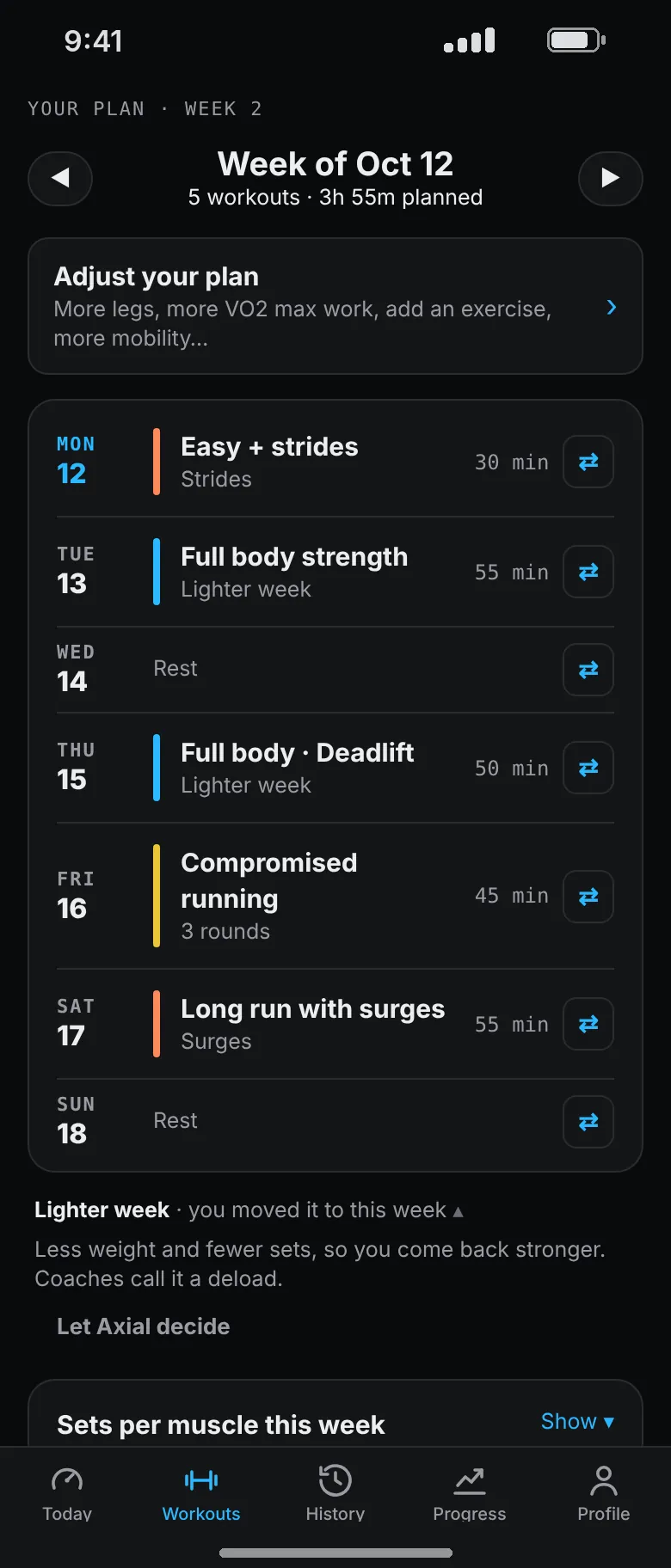
One tap and the same week drops to 3 h 55 min. Lighter lifting, three rounds instead of four, a shorter long run.

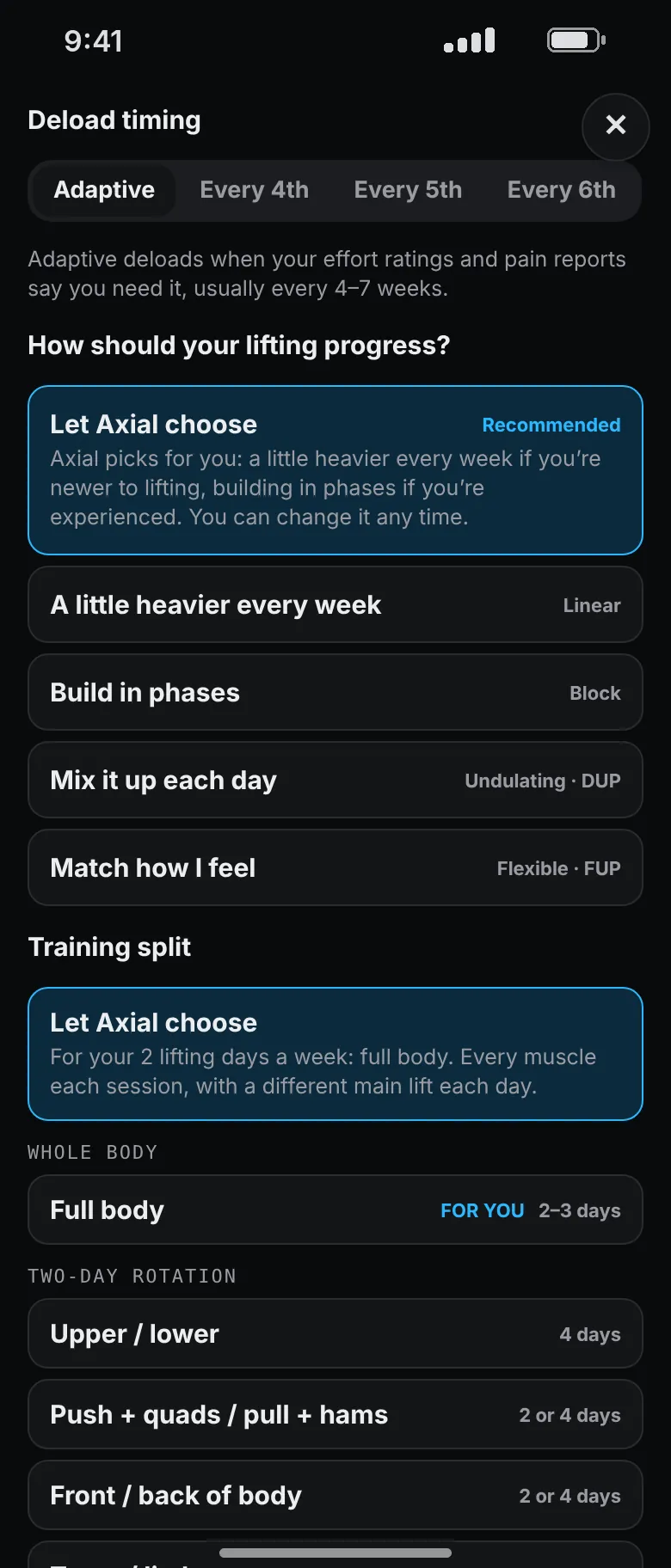
Choose adaptive, or a deload every 4th, 5th or 6th week.

Week 2 of a plan, 5 hours 10 minutes in total: 30/30s, full body strength, a deadlift day, compromised running and a long run with surges, with a Take a lighter week now button under the week. The same week as a lighter week, 3 hours 55 minutes in total: easy running with strides, shorter strength days, three hybrid race rounds and a 55 minute long run. The plan setup screen with Deload timing set to Adaptive and the options Every 4th, Every 5th and Every 6th, above the choice of how lifting progresses.

Sample athlete training for strength, running and hybrid racing.

Loads that follow your logging

Log weight, reps and effort. Axial estimates your max, flags personal records and sets your next loads up or down.

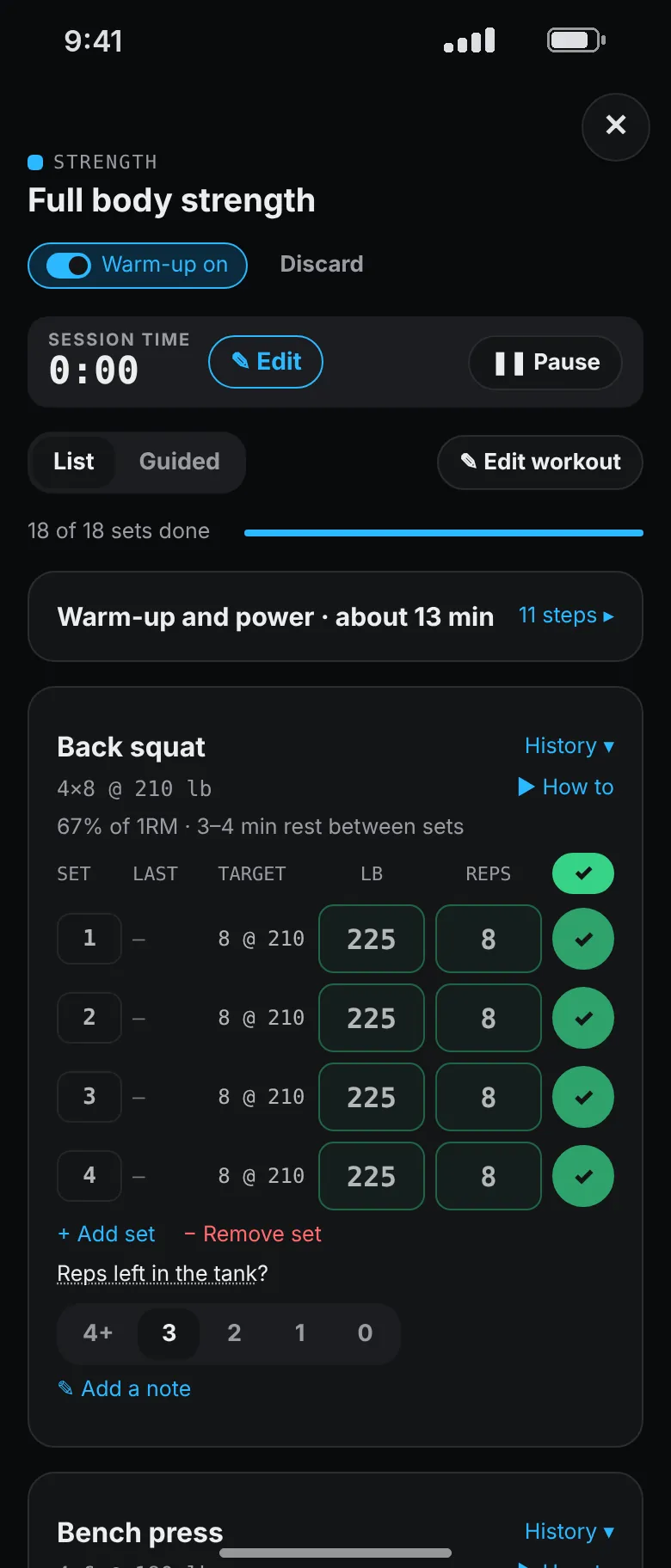
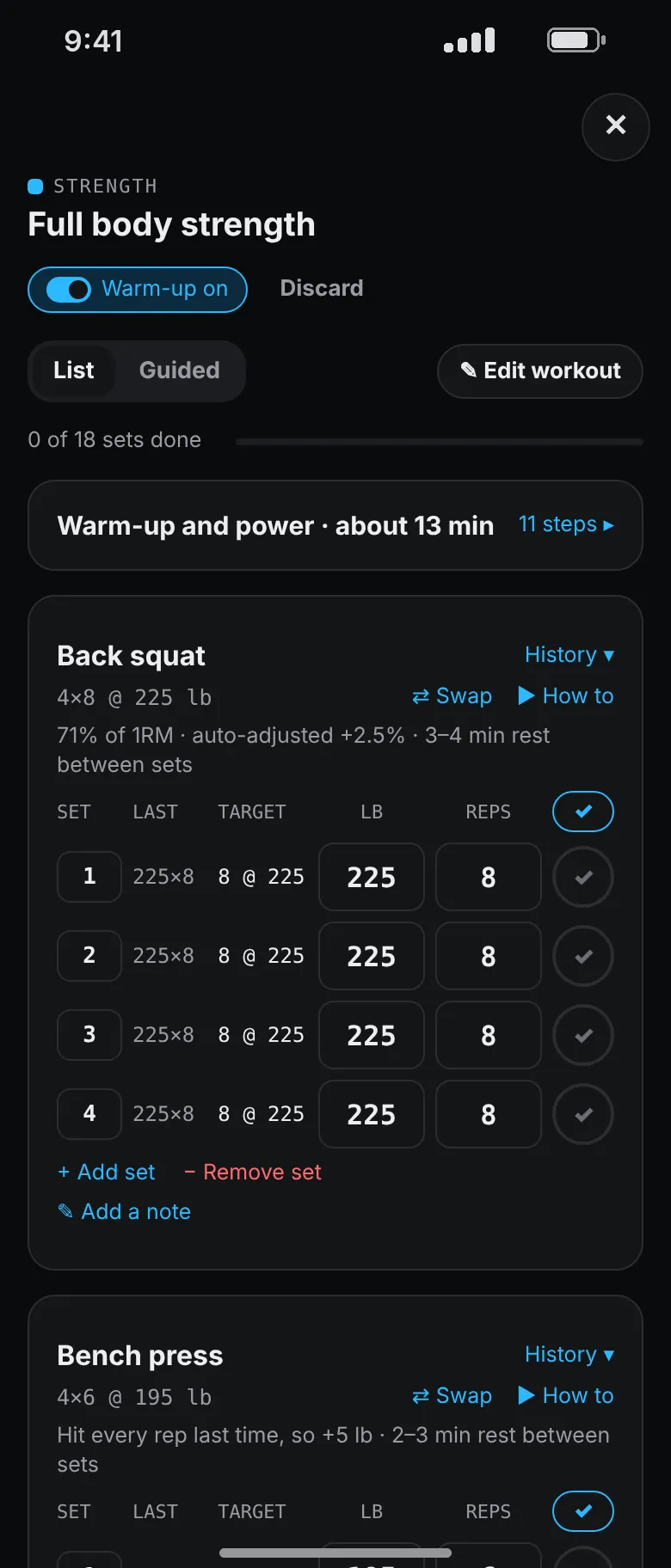
Four sets of eight at 225 lb, against a target of 210.

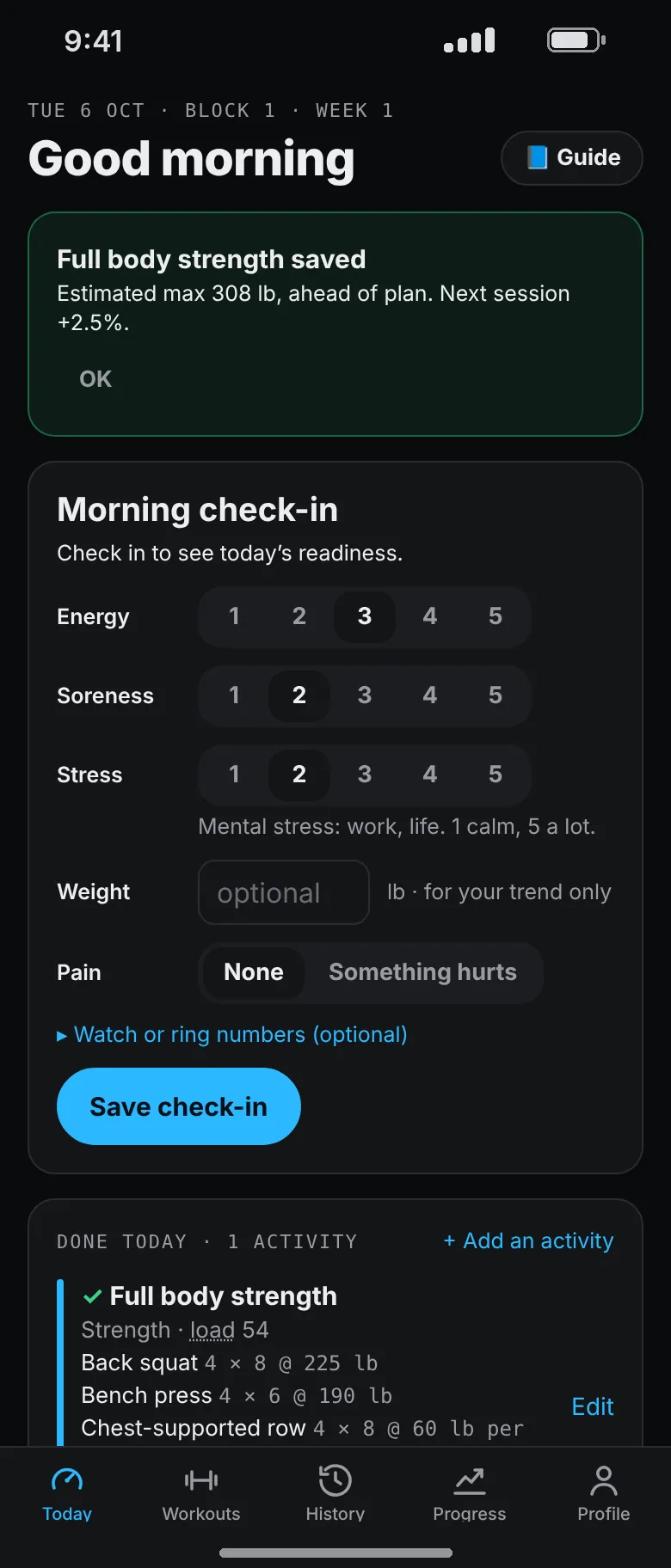
“Estimated max 308 lb, ahead of plan. Next session +2.5%.”

Squat opens at 225 lb with last time beside every set. Bench goes up 5 lb.

Set logging for a back squat: four sets of 8 at 225 pounds, all ticked, against a target of 210, with reps left in the tank set to 3. Today after saving the workout: a message saying estimated max 308 pounds, ahead of plan, next session plus 2.5 percent, above the morning check-in and the finished full body strength session. The next squat day: back squat 4 sets of 8 at 225 pounds with last week’s 225 by 8 shown beside each set, and bench press at 195 pounds with the note hit every rep last time, so plus 5 pounds.

Sample athlete with a 315 lb squat max, logging a squat day.

Say what you want more of

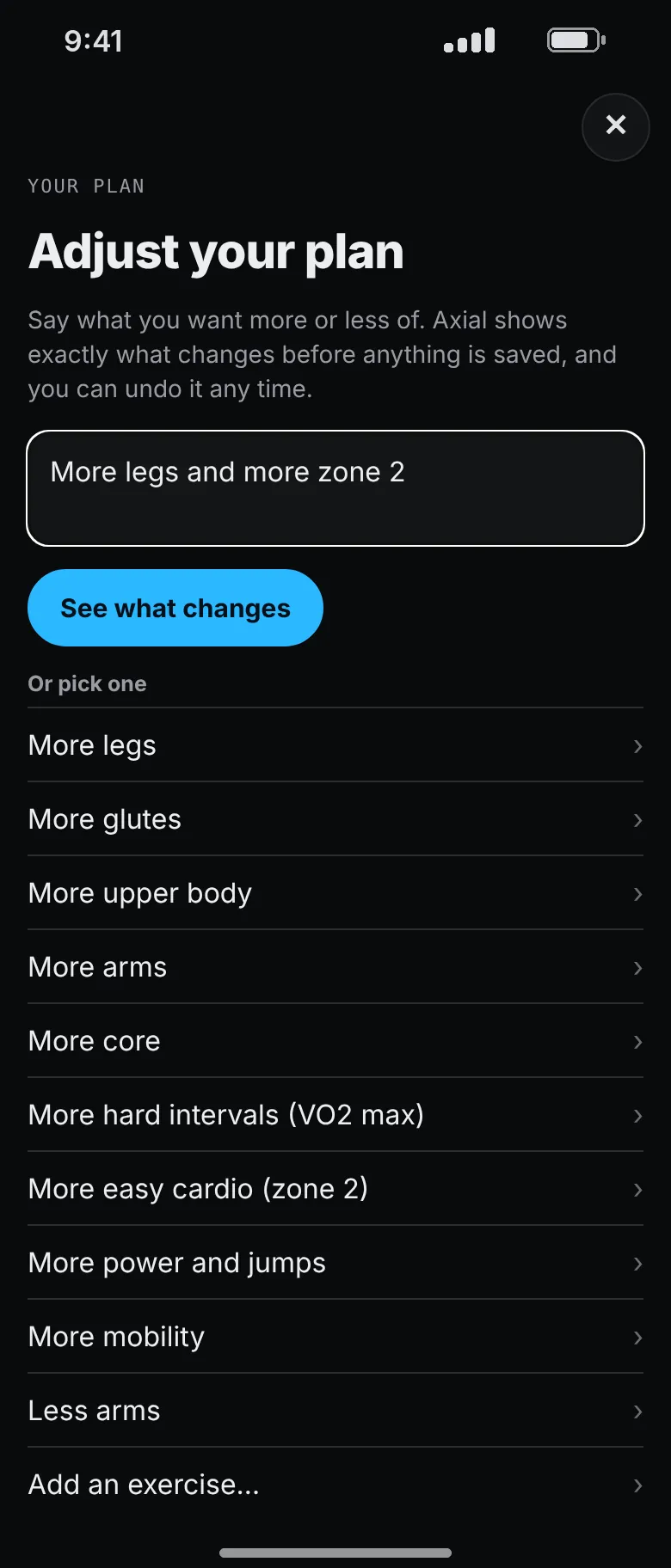
Ask for more legs, more zone 2 or less arms. Axial shows exactly what changes before anything is saved, and you can undo it.

Type it in your own words, or pick one from the list.

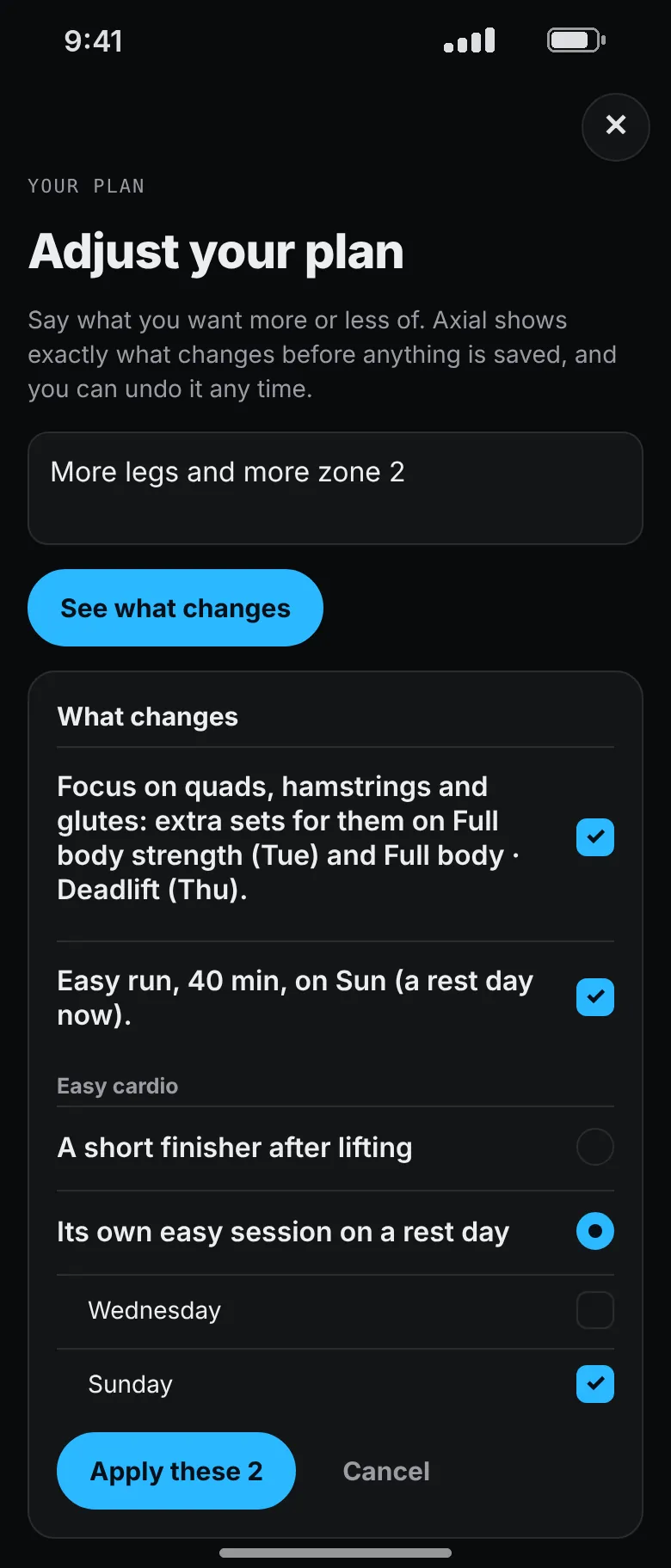
Extra sets for legs on both lifting days, and a 40 minute easy run on Sunday. Nothing is saved until you apply it.

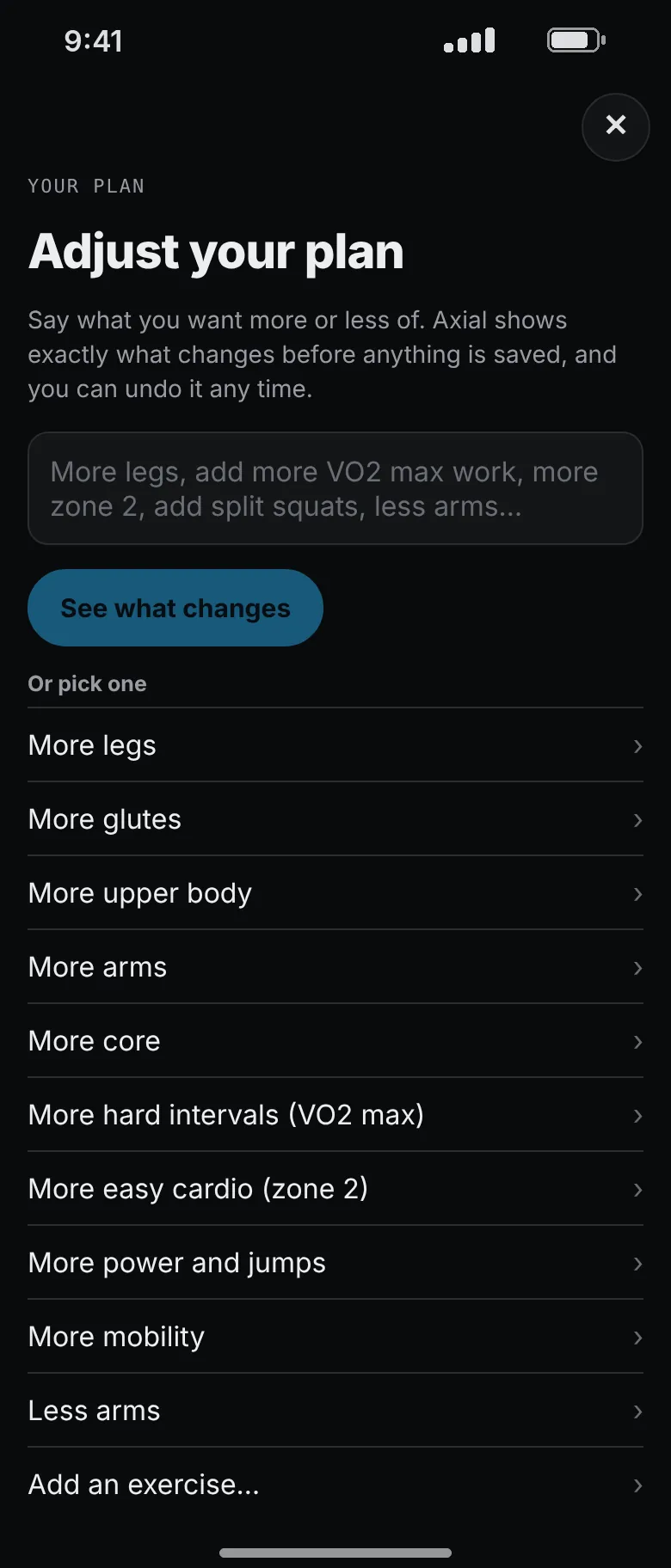
The Adjust your plan screen with “More legs and more zone 2” typed in a box, a See what changes button and a list of options such as more legs, more glutes and less arms. The What changes list: extra sets for quads, hamstrings and glutes on Tuesday and Thursday, and a 40 minute easy run on Sunday, each with a tick box, and an Apply these 2 button.

Sample athlete training for strength, running and hybrid racing.

Pick your split

Full body, upper/lower, push/pull/legs, body part, conjugate and more. Switch any time and the rest of the plan rebuilds, with hard sets counted for every muscle.

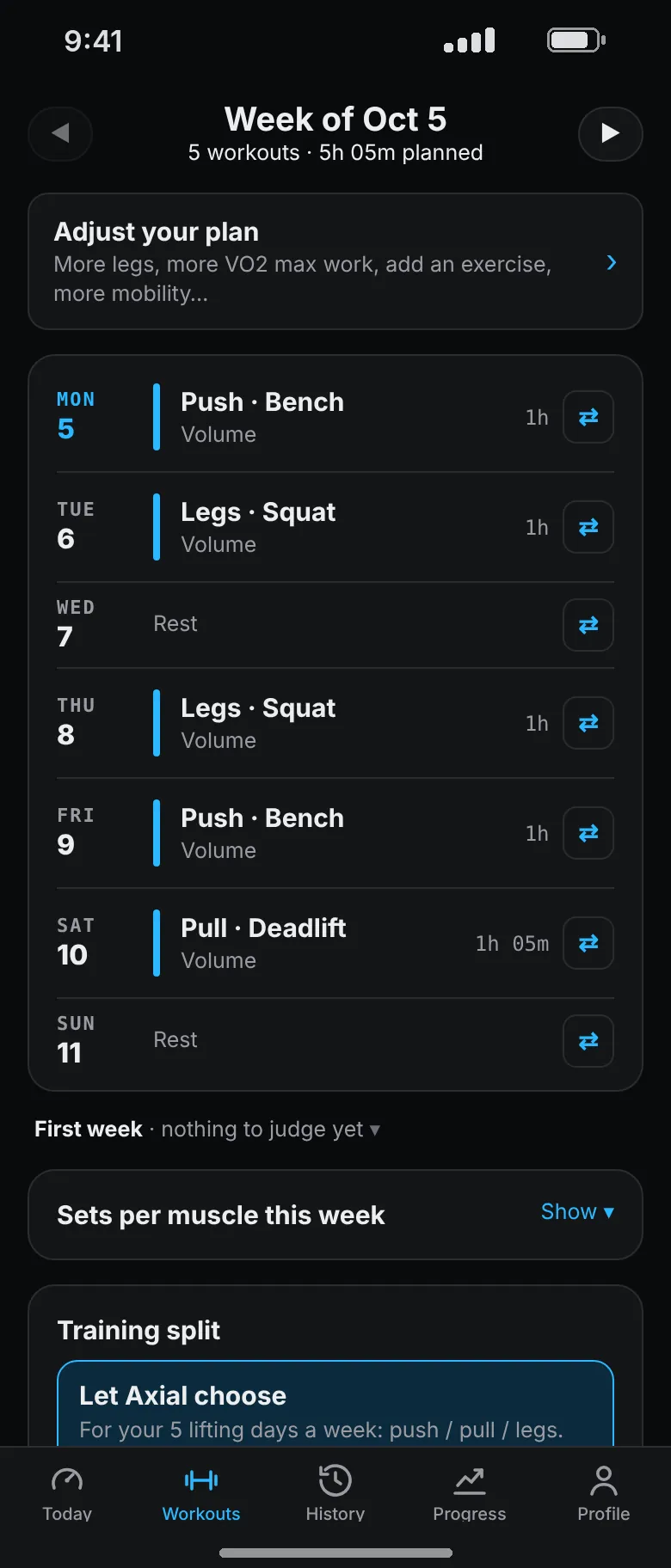
With five lifting days it chose push / pull / legs.

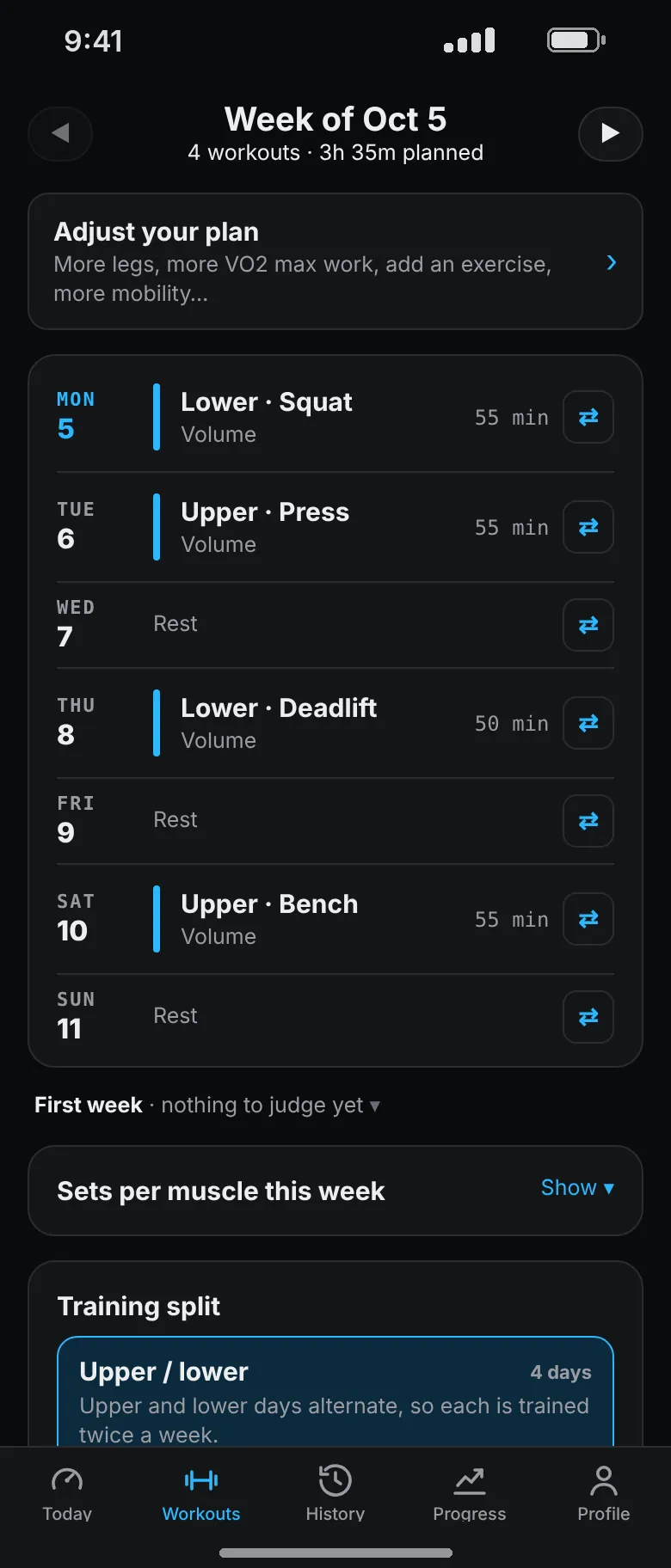
Four days. Each half is trained twice a week.

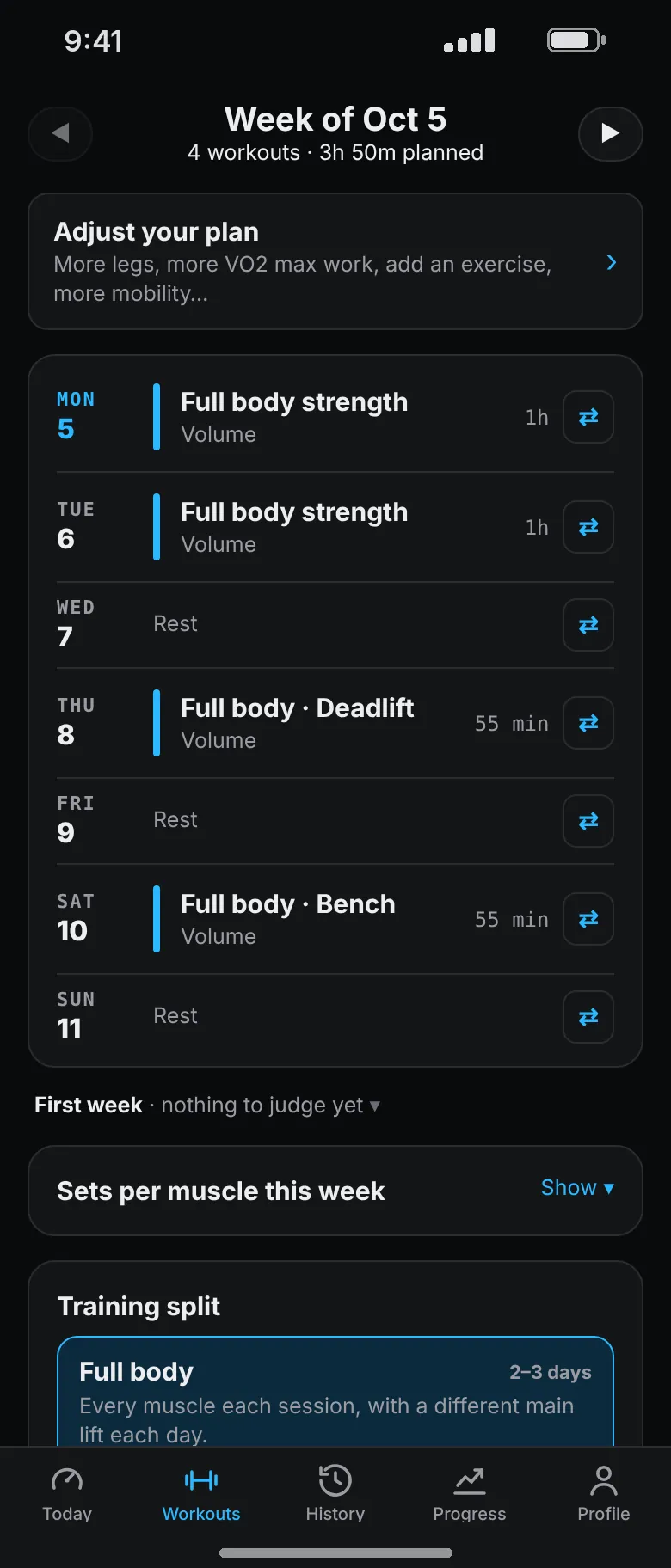
Every muscle each session, with a different main lift each day.

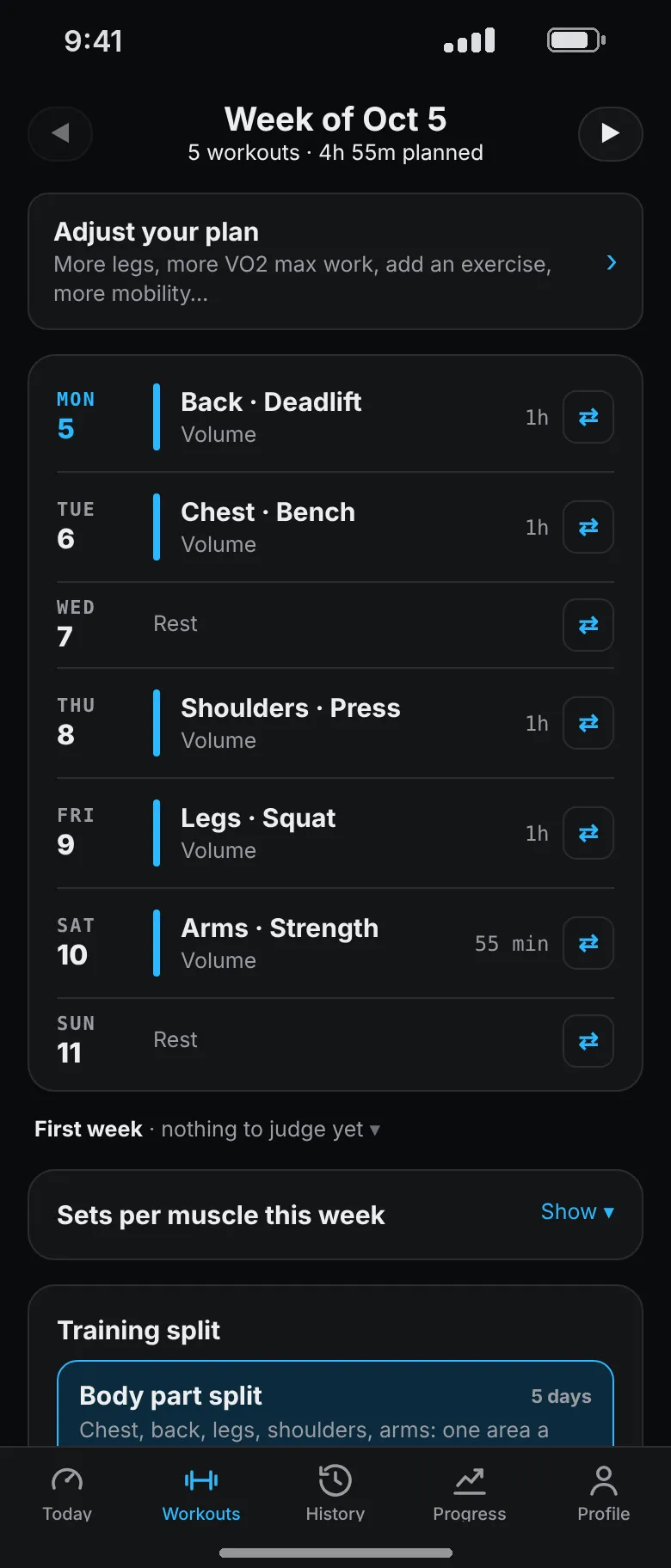
Back, chest, shoulders, legs and arms, one area a day.

Week 1 as push, legs, legs, push and pull days, about five hours, with the training split set to Let Axial choose: push, pull, legs for five lifting days. Week 1 rebuilt as lower squat, upper press, lower deadlift and upper bench, 3 hours 35 minutes, with the training split set to Upper / lower. Week 1 rebuilt as four full body days: strength, strength, deadlift and bench, with the training split set to Full body. Week 1 rebuilt as back with deadlift, chest with bench, shoulders with press, legs with squat and arms, with the training split set to Body part split.

Sample strength athlete with five days a week free.

Works around injuries

Tell it about a knee, low back, shoulder, Achilles, hip or chest issue and exercises that tend to aggravate it get swapped out. It supports care from a clinician and doesn’t replace it.

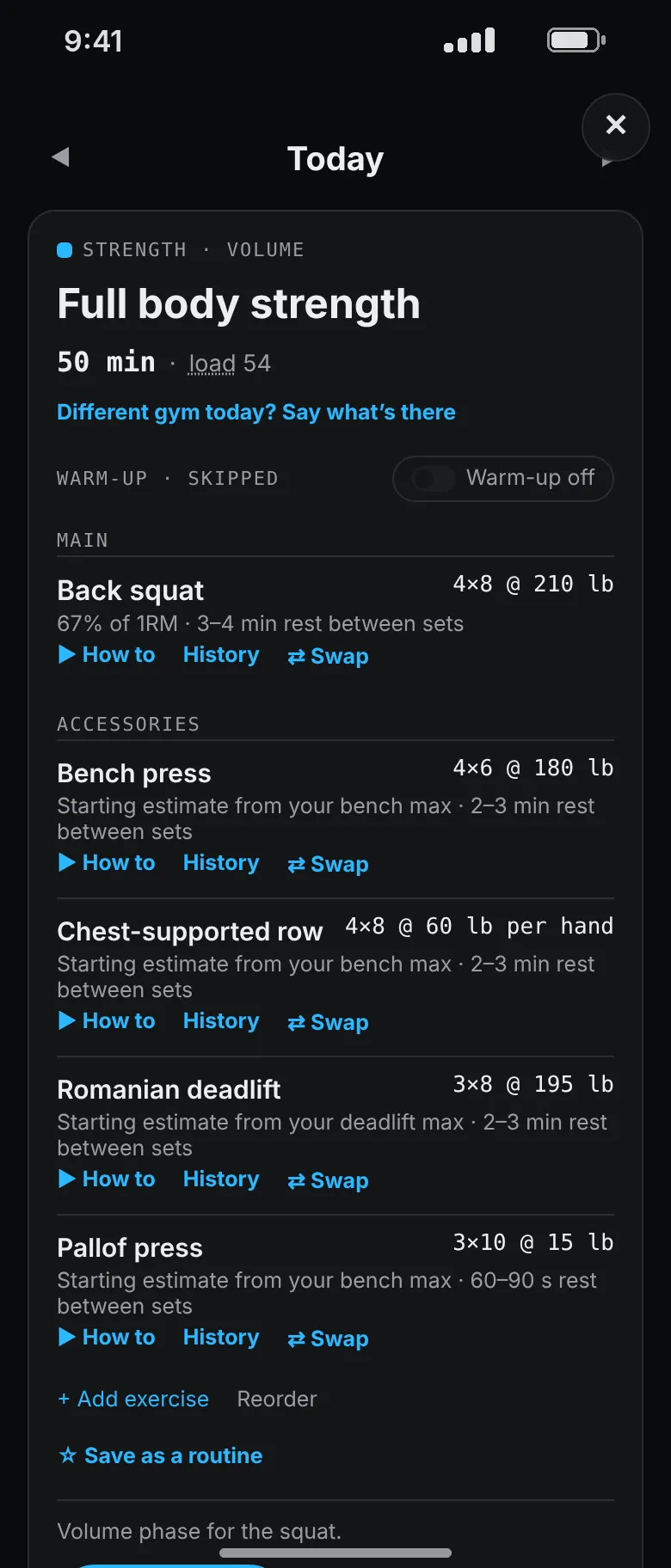
Back squat, 4 sets of 8 at 210 lb.

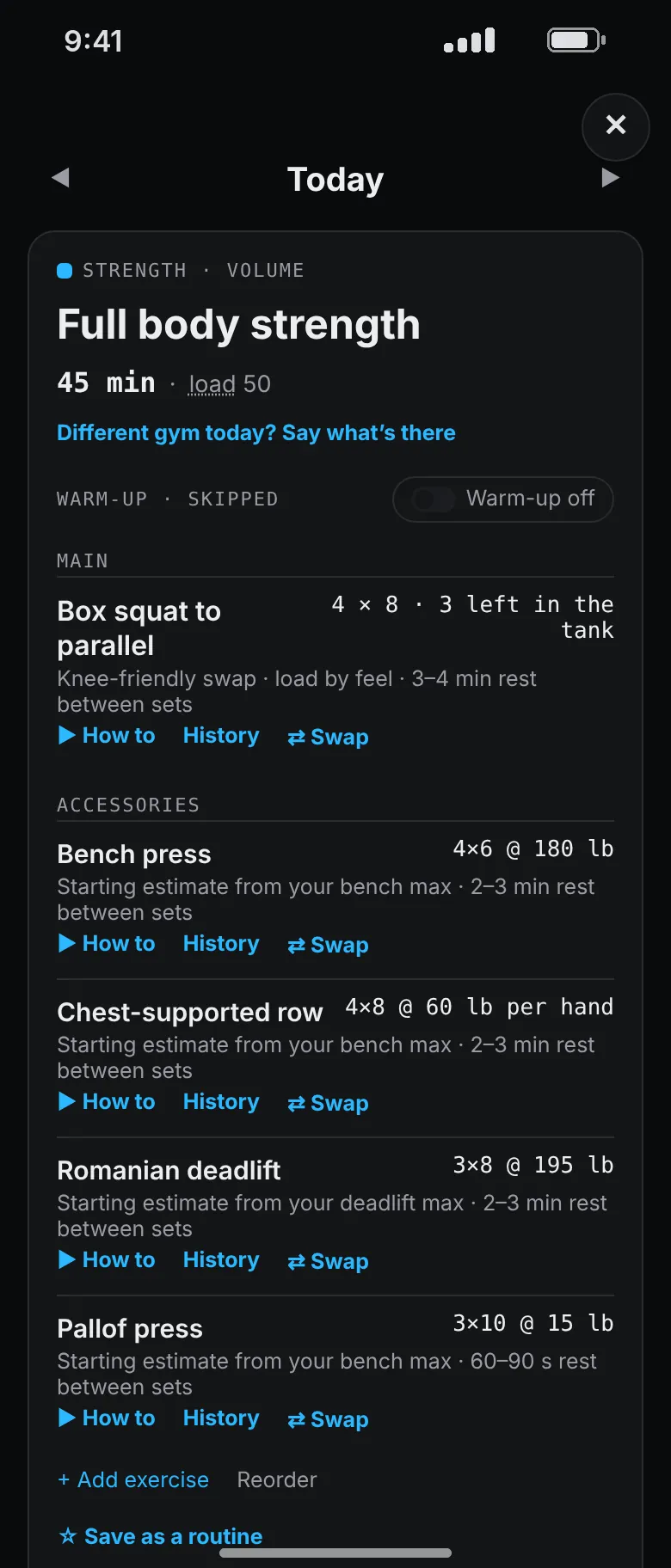
Box squat to parallel, marked as a knee-friendly swap.

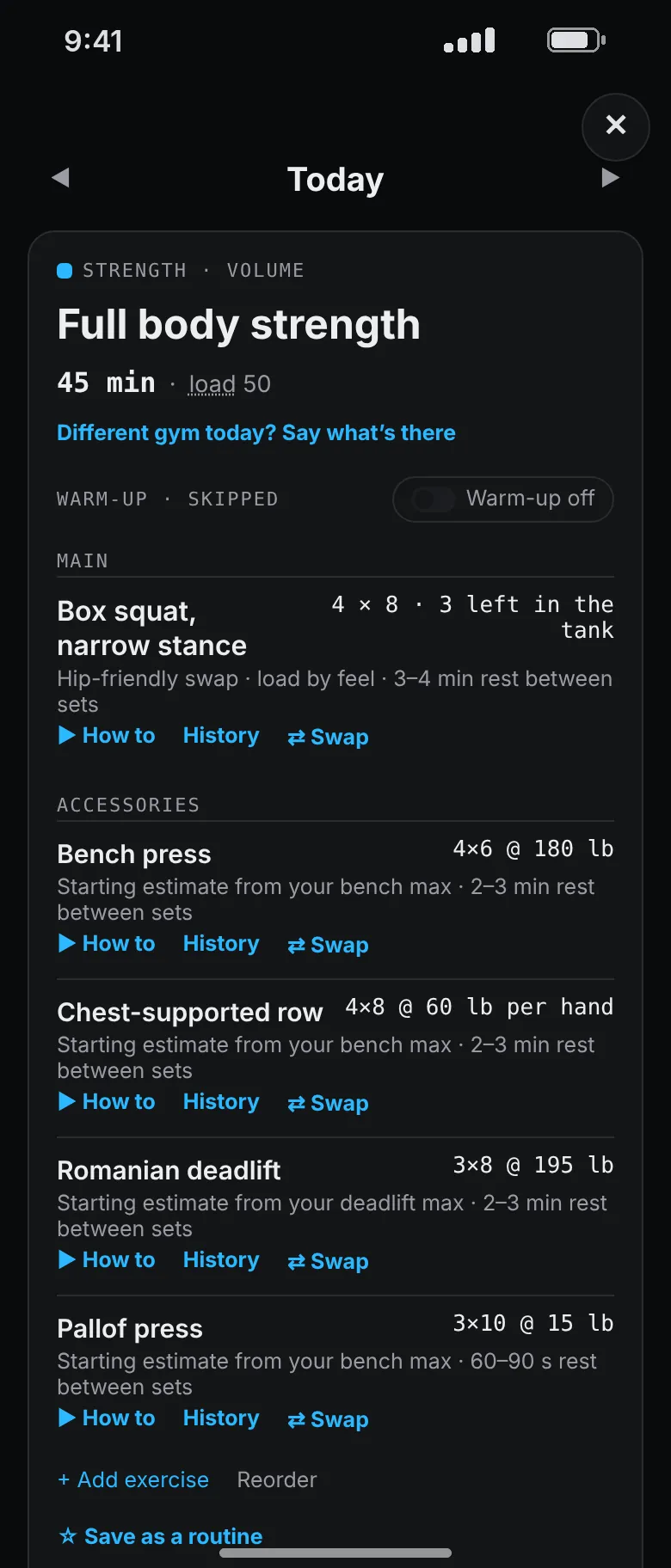
Box squat with a narrow stance, marked as a hip-friendly swap.

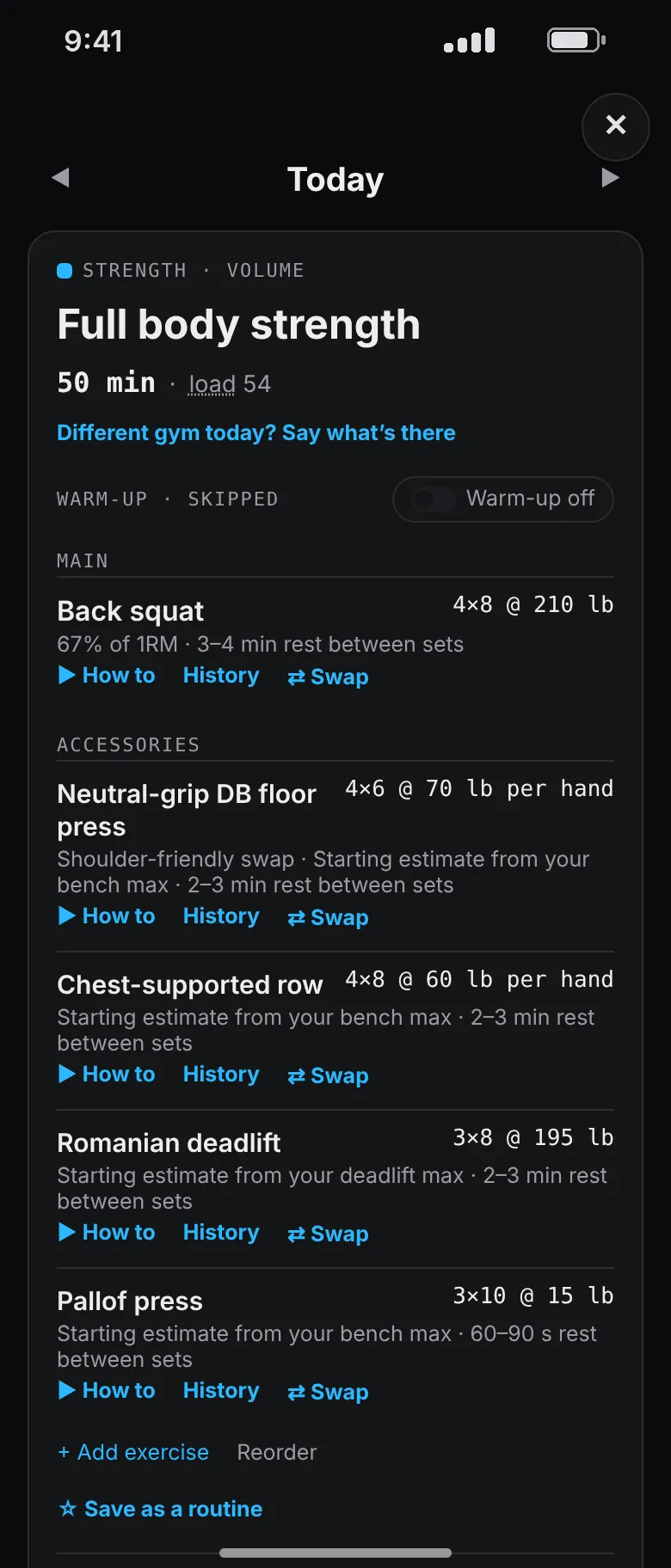
Neutral-grip dumbbell floor press takes the place of the bench press.

A bodyweight back extension takes the place of the Romanian deadlift.

A full body strength session whose main lift is the back squat, 4 sets of 8 at 210 pounds. The same session with a knee limit: the back squat is replaced by a box squat to parallel, marked as a knee-friendly swap with the load set by feel. The same session with a hip limit: the back squat is replaced by a narrow-stance box squat, marked as a hip-friendly swap with the load set by feel. The same session with a shoulder limit: the bench press is replaced by a neutral-grip dumbbell floor press at 70 pounds a hand, marked as a shoulder-friendly swap. The same session with a low back limit: the Romanian deadlift is replaced by a bodyweight 45 degree back extension, marked as a low back-friendly swap.

The same full body day for an athlete with no limits, then a knee, hip, shoulder and low back limit.

Responds to pain

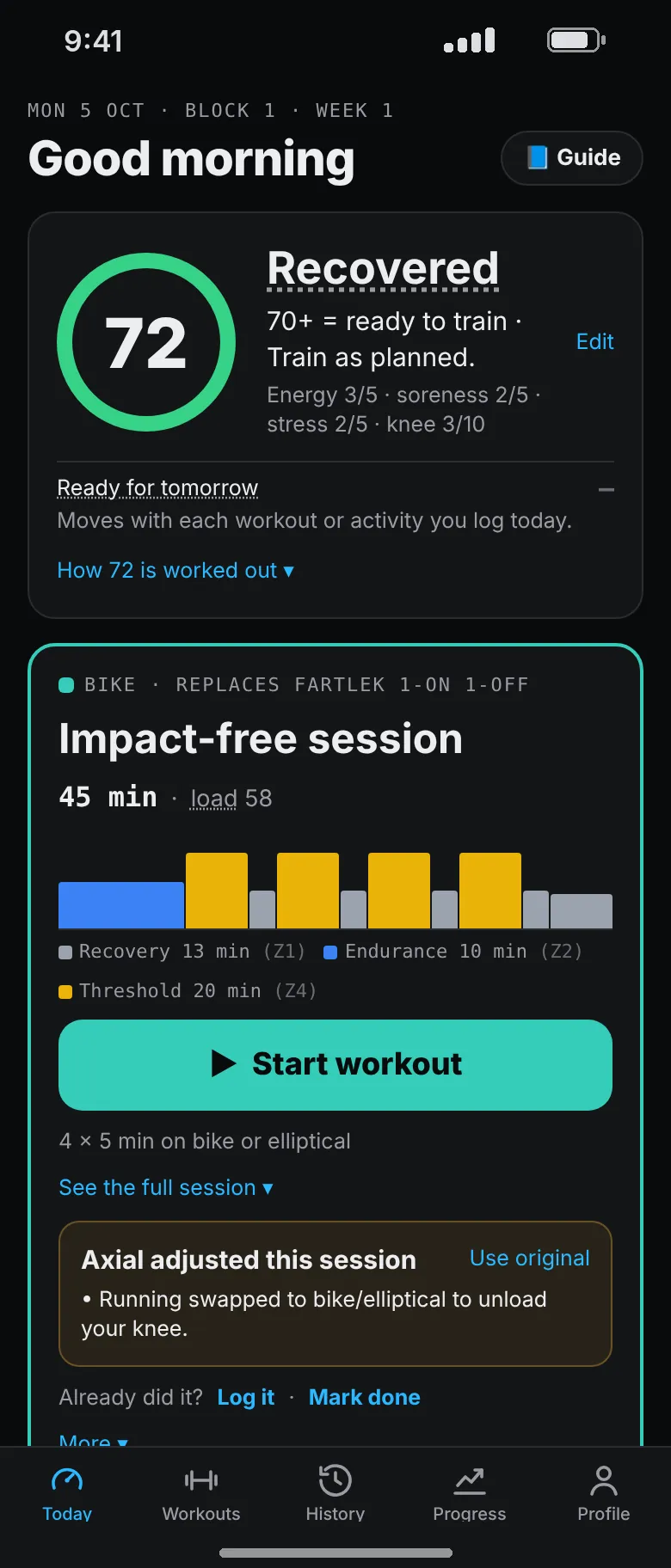
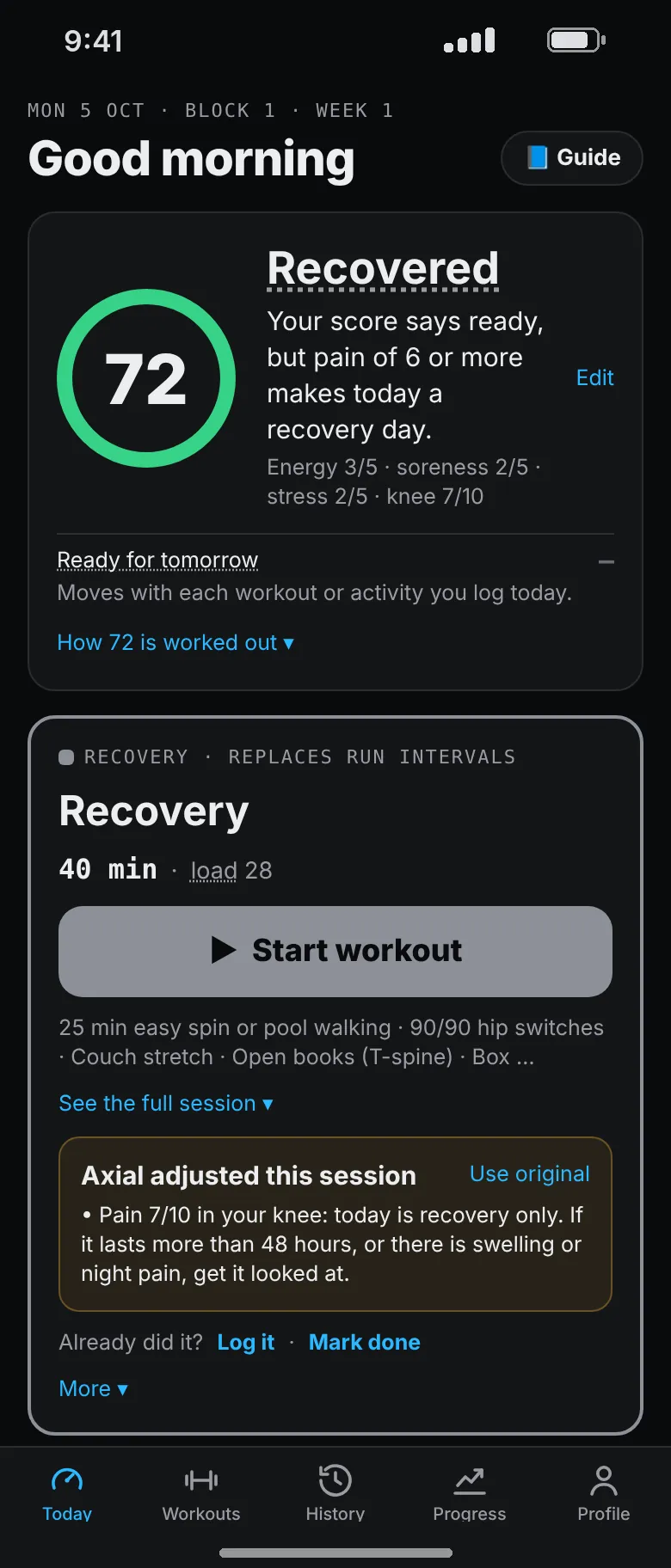
Pain reports move runs to low-impact work. Strong pain turns the day into recovery and tells you to get it checked.

Fartlek, as planned.

Running becomes a 45 minute bike or elliptical session.

Recovery only, with a note to get it looked at.

Today with a readiness score of 72, then a fartlek run of 45 minutes with a zone chart and a Start workout button. Today after reporting knee pain of 3 out of 10: an impact-free bike session replaces the fartlek run, with a note that running was swapped to bike or elliptical to unload the knee. Today after reporting 7 out of 10 knee pain: a recovery session replaces the run, with a note that today is recovery only and to get it looked at if it lasts more than 48 hours or brings swelling or night pain.

Same morning, same sample athlete. Only the pain entry in the check-in changes.

Different gym today?

Rebuild any session for the equipment in front of you. Tomorrow goes back to plan.

Ski erg, sled push at 335 lb and sled pull at 225 lb.

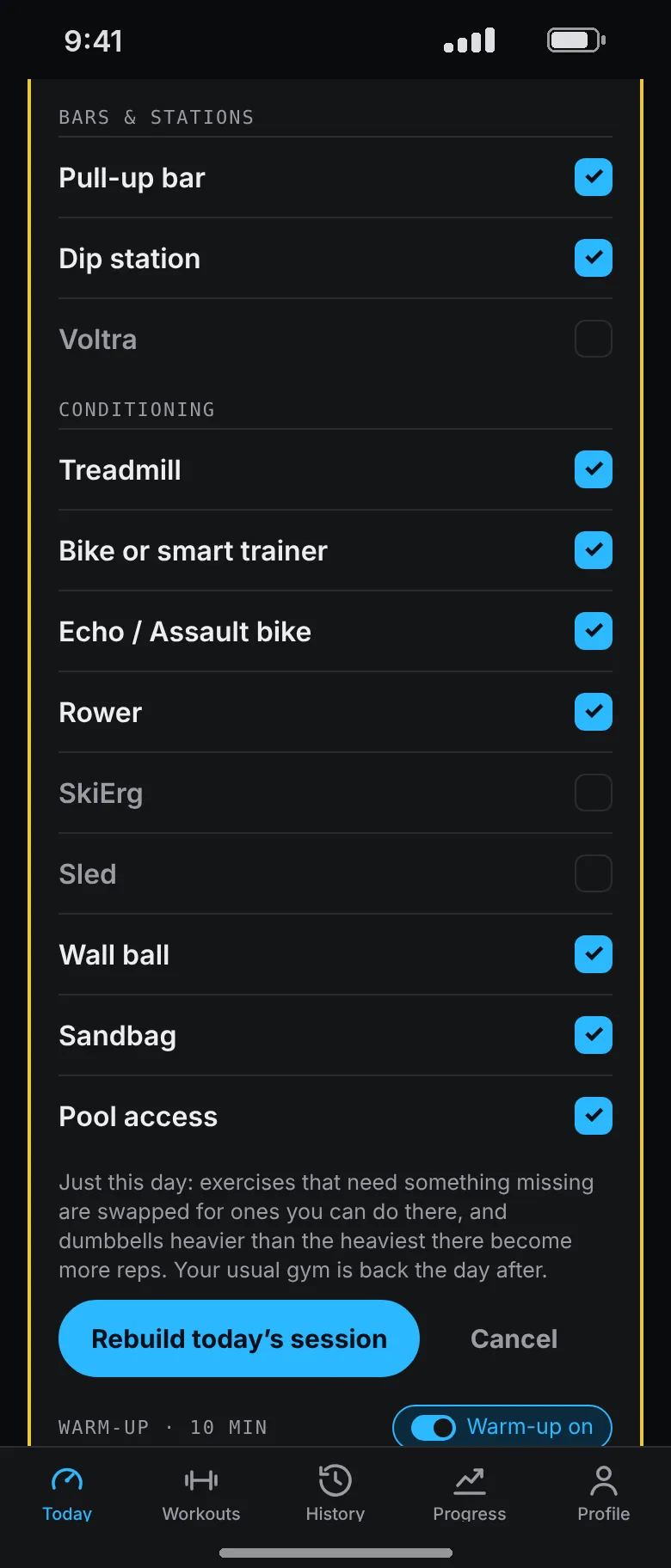
Untick what this gym doesn’t have.

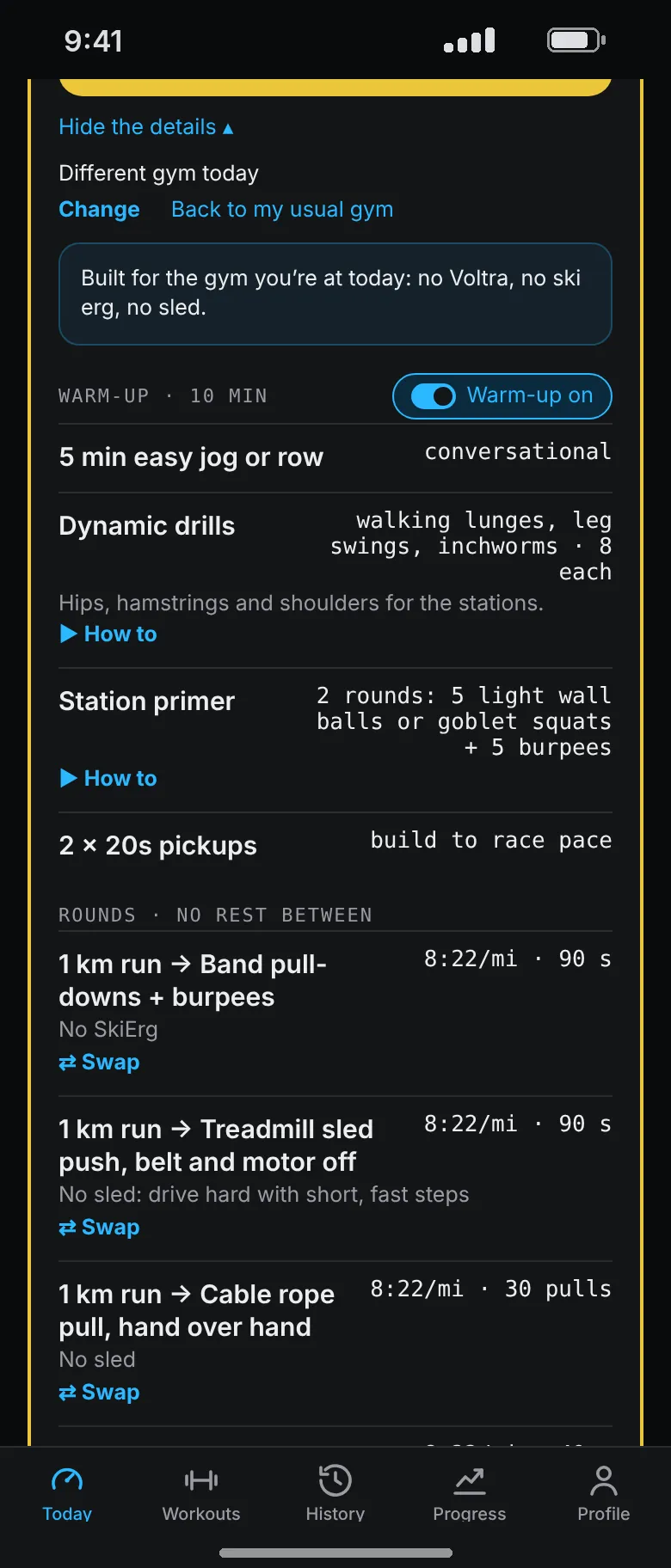
Band pull-downs, a treadmill push and a cable rope pull take their place.

A hybrid race session’s rounds: a 1 km run into the Ski erg, sled push at 335 pounds, sled pull at 225 pounds and burpee broad jumps. The equipment list for a different gym today, with the Ski erg and sled unticked and Rebuild today’s session below. The same hybrid race session rebuilt: band pull-downs with burpees, a treadmill sled push with the belt off, and a cable rope pull, each noting what is missing.

Friday’s hybrid race session for the sample athlete, rebuilt for a gym with no Ski erg or sled.

Bring your coach’s plan

If a coach writes your workouts, paste them in. Axial puts them on their days, logs them and keeps your records without changing a thing.

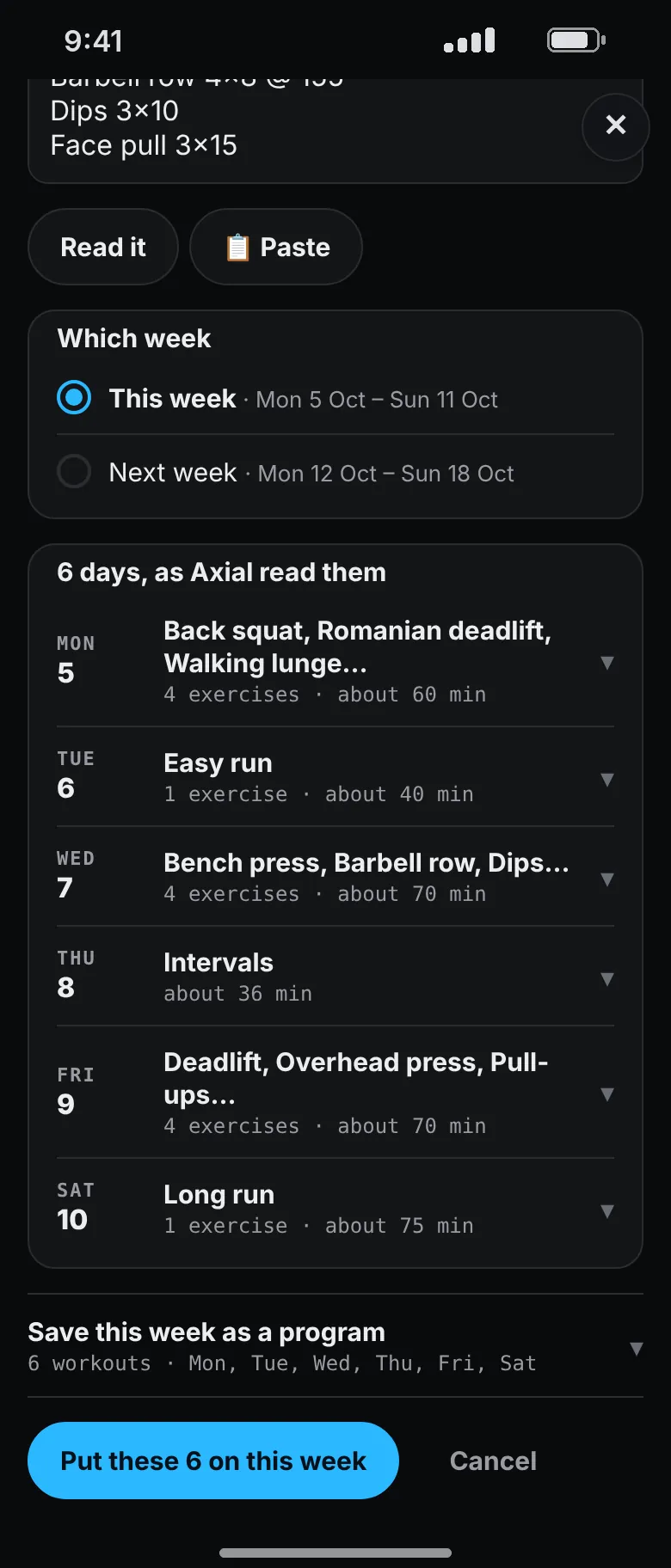
Copy it from a message, email or sheet. Axial reads each day and shows it to you first.

Their weights, sets and reps, as written. You log it like any other workout.

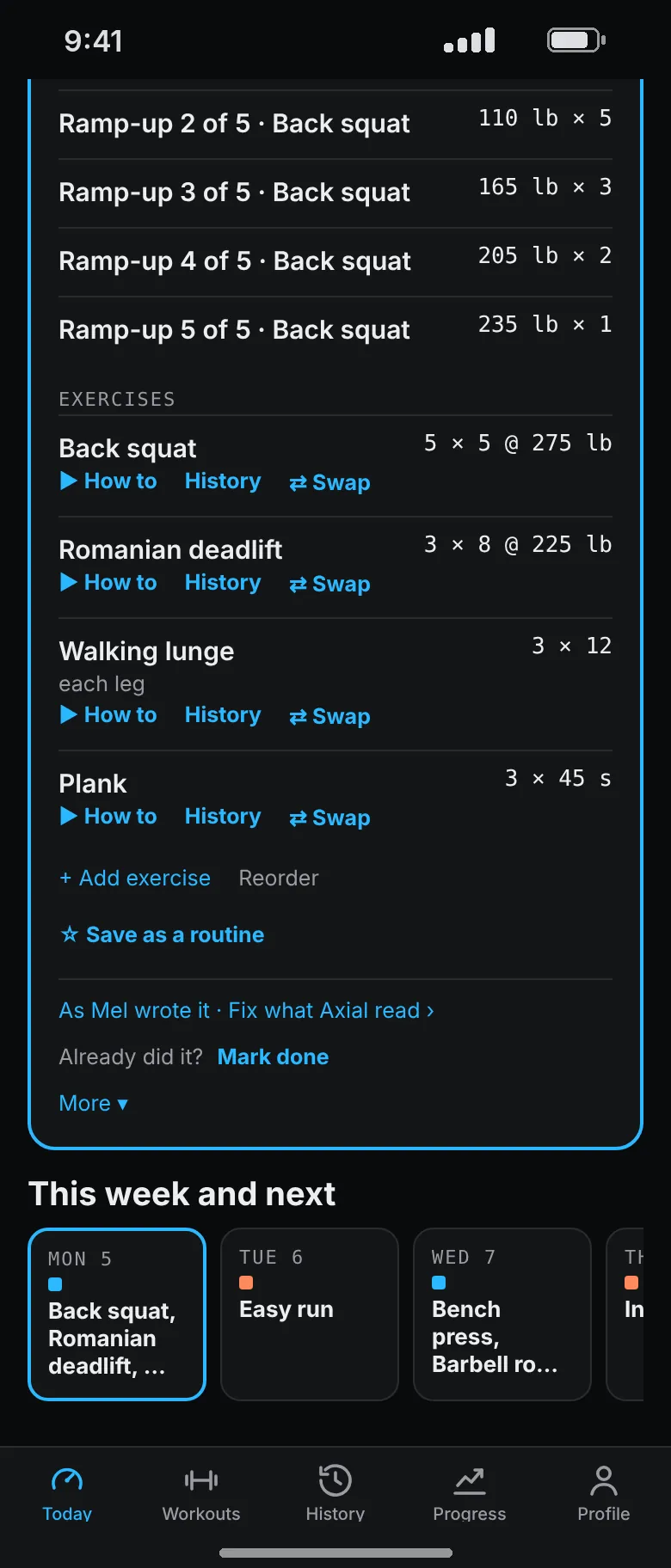
The paste screen for a coach’s plan: six days read from a pasted week, from Monday’s squat day to Saturday’s long run, with a button to put them on this week. Monday’s workout from the coach: warm-up sets before a back squat of 5 by 5 at 275 pounds, then Romanian deadlift 3 by 8 at 225, walking lunges and planks, with a note that it is as Mel wrote it.

A made-up week from a made-up coach called Mel.

Take it to your watch

Send structured workouts to a Garmin as .FIT files, or to Zwift as .zwo and .erg files. Import finished activities from Garmin, Wahoo, COROS, Strava or Zwift.

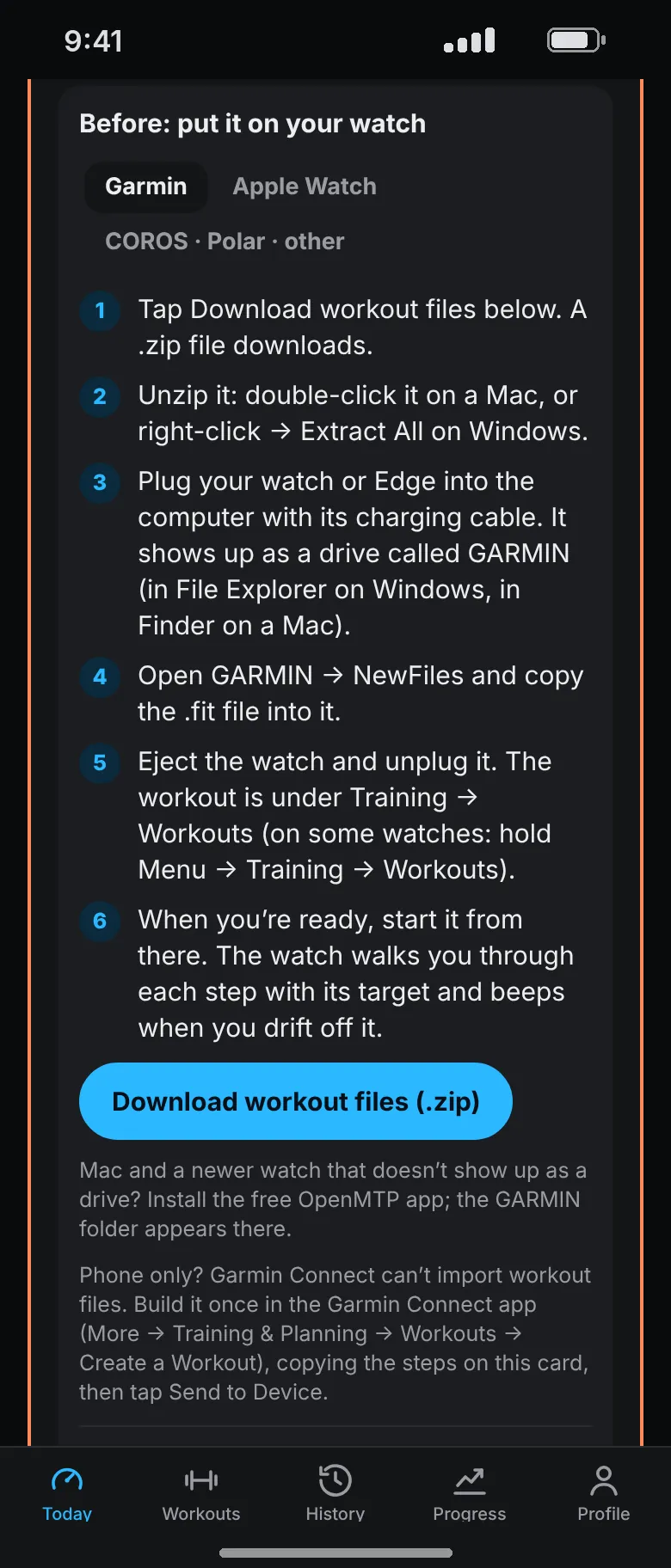
Step by step for Garmin, Apple Watch and others, with the workout file ready to download.

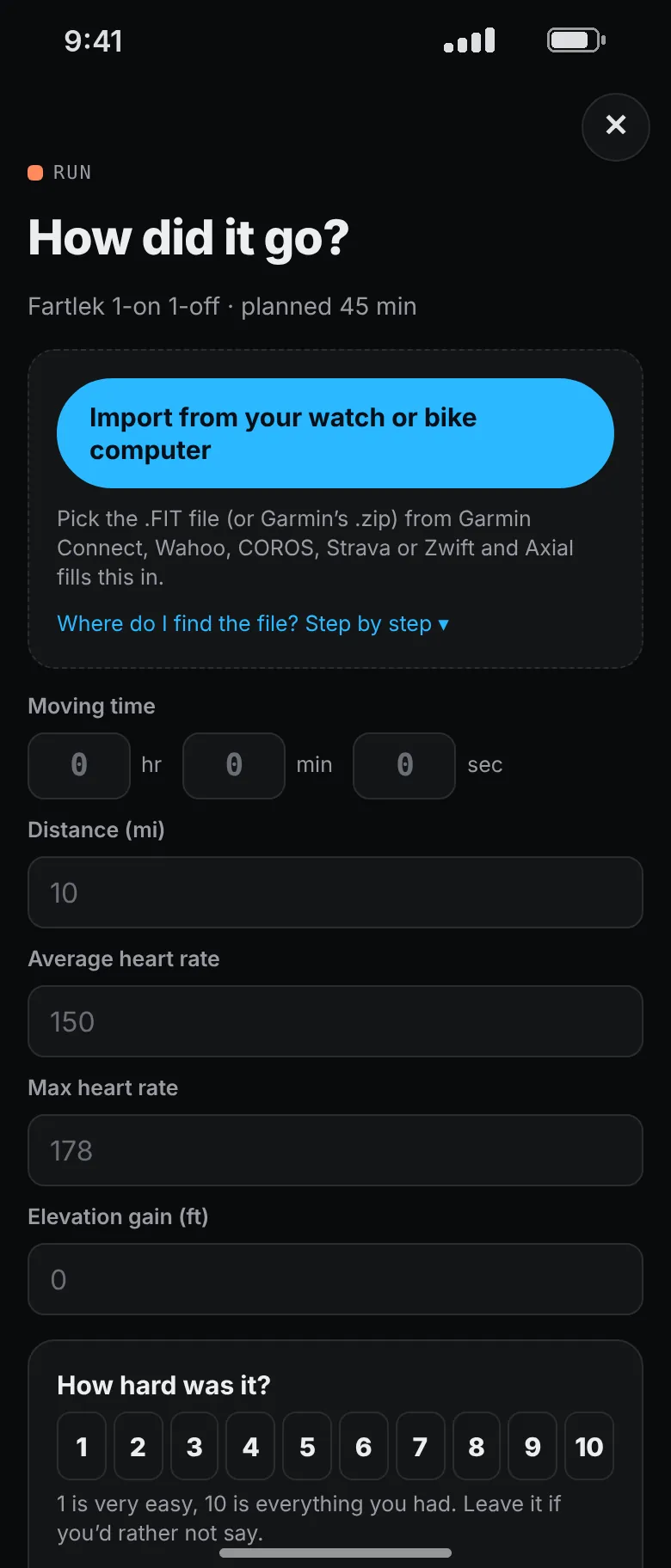
Import the file your watch recorded and Axial fills in the session.

The Send to watch panel for a Garmin: six steps from downloading the workout file to starting it on the watch, and a Download workout files button. The log screen for a run, with an Import from your watch or bike computer button above time, distance and heart rate boxes.

A fartlek run for the sample athlete.

Your data stays yours

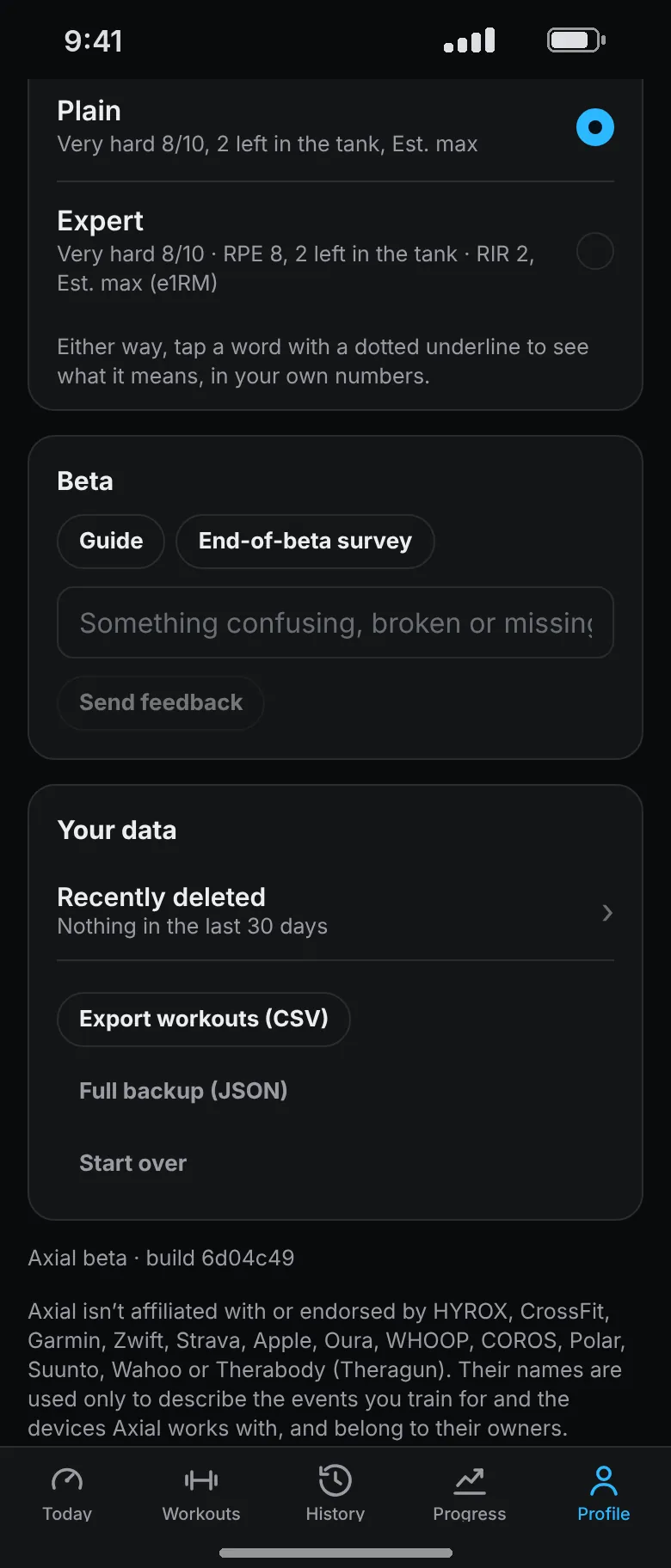
Export your workouts as CSV or a full backup as JSON. Delete your account and everything stored with it from inside the app.

The Your data card in Settings with Recently deleted, Export workouts as CSV, Full backup as JSON and Start over.

Under Profile, Settings, Your data.

Mobility that fits your week.

On a rest day, Axial suggests an optional follow-along mobility routine of 10 to 30 minutes, one drill at a time, with doses that build as you keep at it.

Matched to your training

The routine is picked from the last two days of your plan and the activities you logged, so a day after a run looks different from a day after lifting.

Doses that build

Each drill starts at a set dose, such as 8 each side or a 30 second hold. As you repeat it, holds get longer, reps go up, then a set is added. A lighter week or pain in that area can hold a dose or ease it.

One tap for how it felt

After the routine, mark each drill easy, OK or rough, or skip it. Easy can move a dose up sooner; rough takes it back a notch.

A reset for a day off

Nothing on your plan in the last two days? You get a general reset instead. You can also pick another routine or build your own.

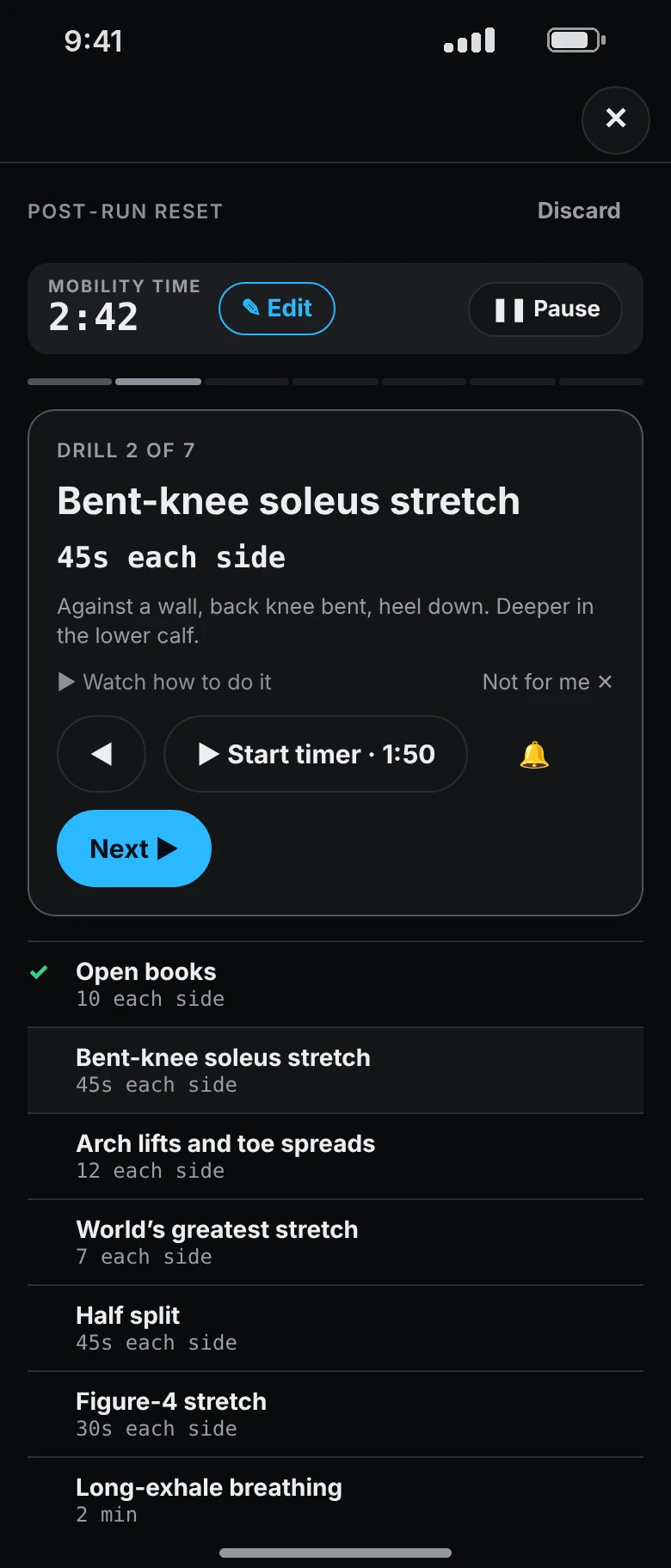
A rest-day mobility routine called post-run reset, on drill 2 of 7: a bent-knee soleus stretch for 45 seconds each side with a Start timer button, the mobility clock at 2 minutes 42, and the list of drills with open books ticked, each with its dose.

Sample athlete training for strength and running, on a rest day. Move slowly, and stop any drill that pinches or hurts.

What it looks like

  • The Adjust your plan screen: a box to type what you want more or less of, a See what changes button, and a list of options such as more legs, more glutes, more hard intervals and more mobility.
    AdjustSay what you want more or less of. See what changes before you save.
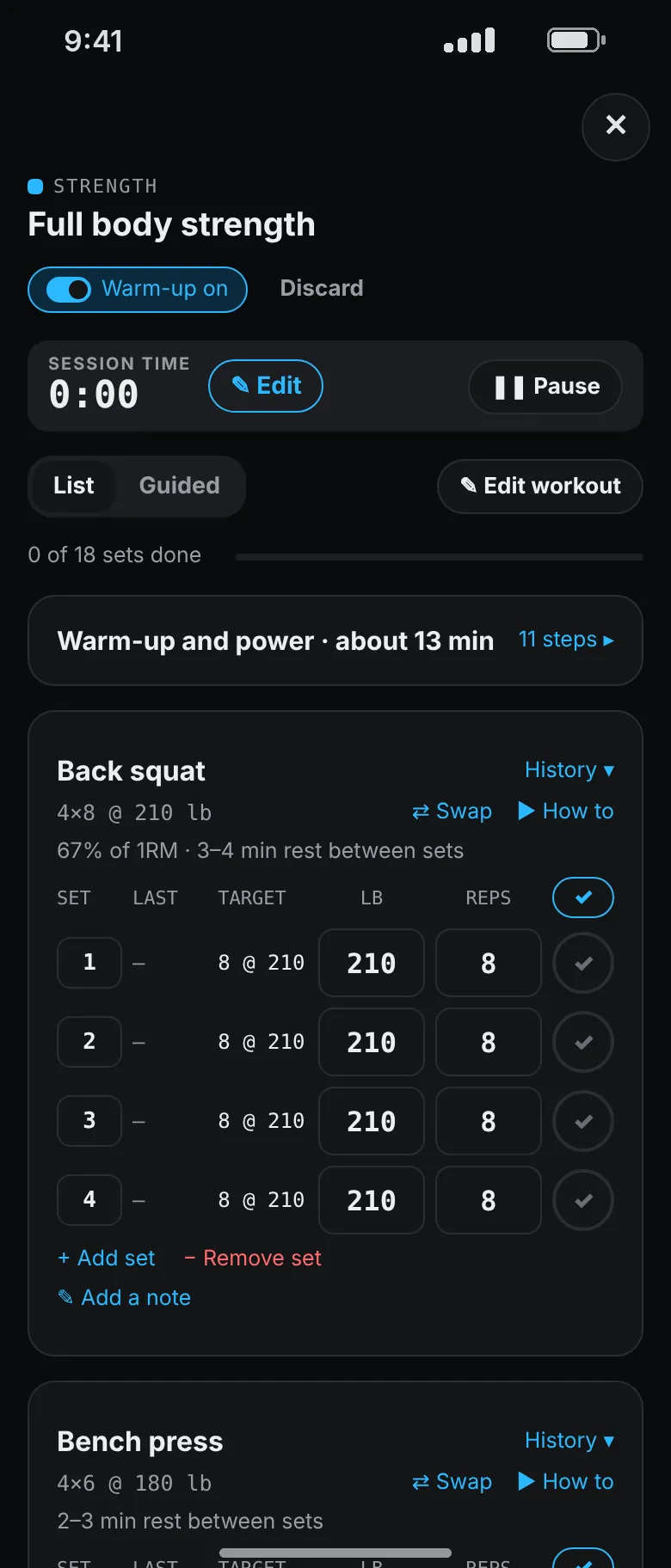
  • Set logging for a back squat, four sets of eight at 210 pounds, with weight and reps boxes and a tick for each set.
    SessionLog each set. Loads come filled in from your plan.
  • Week one of a plan, listing a fartlek run marked done, full body strength, a deadlift day, compromised running and a long run.
    PlanA week of mixed sessions, color-coded by sport.
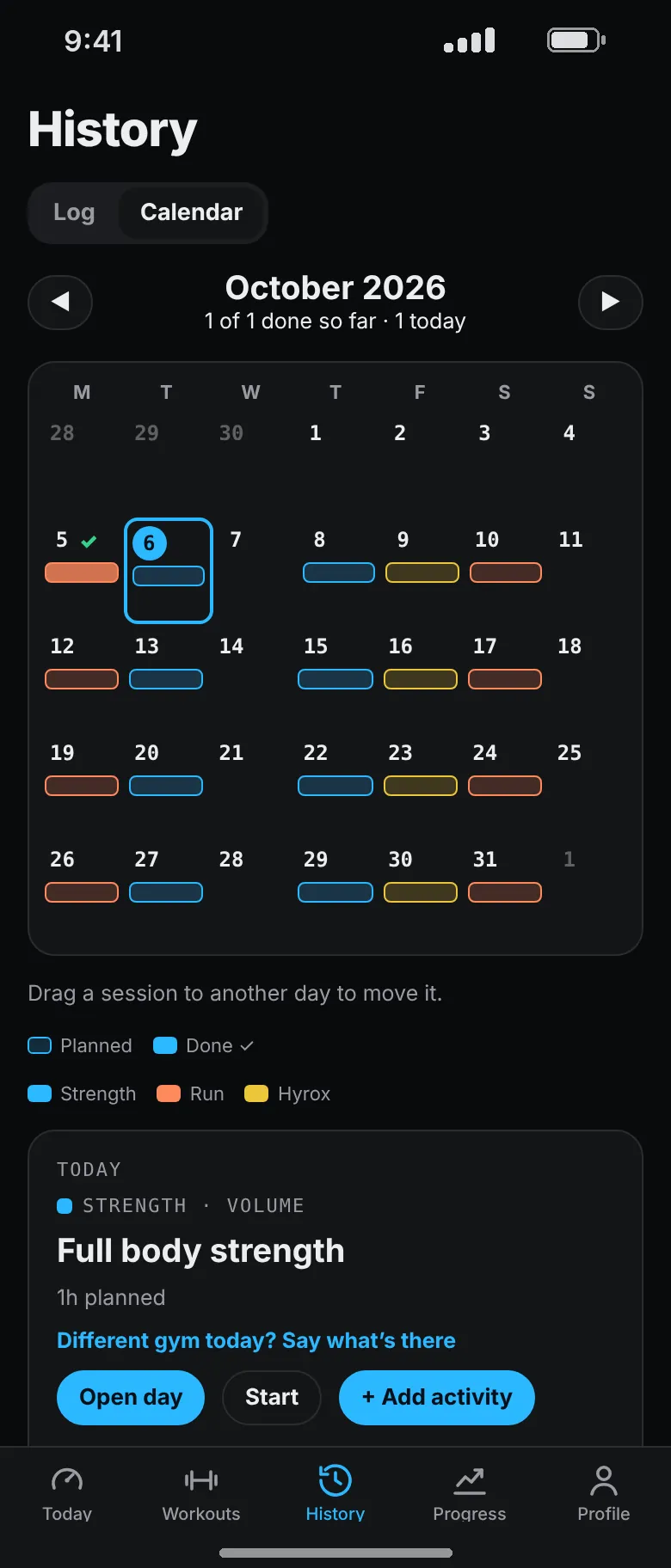
  • A month calendar with planned runs, strength and hybrid racing sessions in color on their days.
    CalendarWhat you did and the weeks ahead. Drag a session, add time away, or change your training days.

Screens are from the web app, using a sample athlete.

Works with the gear you already use.

Axial works with an Apple Watch through the iPhone app, and with other devices through files and the numbers you type in. Here’s what works today, and where we’re headed.

Out to your watch or trainer

Structured workouts as Garmin .FIT files and Zwift .zwo and .erg files, one session or a whole week at a time. Download the file and copy it to your device.

In from your activities

Import .FIT, .TCX and .GPX files from Garmin, Wahoo, COROS, Strava or Zwift to fill in a workout automatically.

Recovery numbers

Type in HRV, resting heart rate and sleep from your watch or ring when you check in.

Apple Watch and Apple Health

In the iPhone app, send a run, ride, swim or walk to the Workout app on your Apple Watch (iOS 17 and watchOS 10 or later), or record a workout with Axial’s own Apple Watch app. The iPhone app can also read your sleep, HRV, resting heart rate and workouts from Apple Health, if you turn that on.

Where we’re headed

Wahoo and Zwift

Runs sent to a Wahoo KICKR RUN treadmill and rides sent to Zwift, with no file to copy.

No dates on these yet: most need the other company’s go-ahead first.

Questions

What does Axial cost?

Pricing isn’t set yet.

What do I need to start?

A phone or computer with a web browser and an email address for your account. On iPhone, open the web app in Safari and use Share, then Add to Home Screen. The iPhone app is coming to the App Store.

Does it sync with my watch automatically?

It depends on the watch. With an Apple Watch, the iPhone app can send a run, ride, swim or walk to the Workout app on the watch, Axial’s own Apple Watch app can record a workout and save it to your log, and the iPhone app can read your sleep, HRV, resting heart rate and workouts from Apple Health. With Garmin and Zwift, not yet: workouts go out as files you download and copy over, and finished activities come back as files you import. For other watches, bike computers and trainers, Axial gives you a workout file to load. Recovery numbers from other devices are typed in when you check in.

Does Axial use AI?

Not to plan your training. Your plan comes from a rule-based coaching engine, and the app doesn’t send your data to an AI model. The Axial team doesn’t give your health information or account data to AI assistants. It may use AI assistants, such as Claude, to read feedback with names, email addresses and health details removed and to work on Axial’s code. The details are in the privacy policy.

What happens to my data?

Your plan, check-ins and logs are saved to your account so they follow you to a new phone. The Axial team looks at them to fix problems only if you turn on Help test Axial in the app; it’s off for new accounts. We don’t sell your data or use it for advertising.

You can export or delete it from Profile, then Your data. The details are in the privacy policy.

Is this medical advice?

No. Axial is a training tool. Talk to a clinician before you start if you have a medical condition, an injury, or you’re pregnant or recently gave birth. Read the health and safety notice.

Who makes Axial?

Axial is an independent project. Questions and feedback are welcome: see the contact page.

Build your plan in a few minutes.

Set your goals, pick your days and your equipment, and your first week is ready.